Adjusters pay what you can prove. Prove all of it.
The exact photo and video checklist for the first 45 minutes of a Grand Rapids water claim — built from 40+ years of carrier interactions.
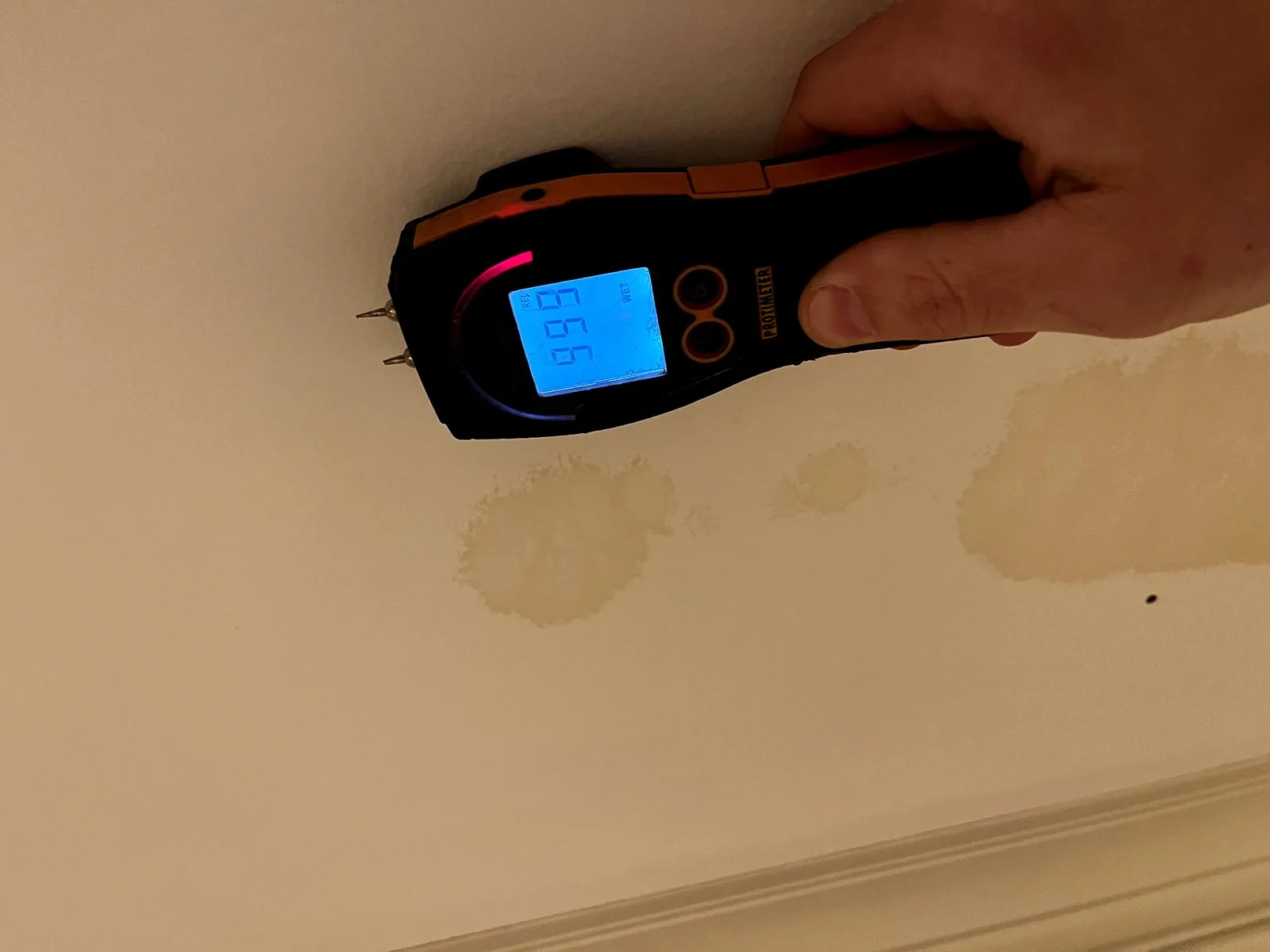 Moisture documentation — ceiling cavity, claim pre-adjuster visit
Wide shots of every affected room from each corner, close-ups of each wet surface with a reference object for scale, a continuous video walkthrough with audio narration, photos of the water source, and inventory of all wet contents before moving anything. Minimum standard: 3–4 photos per room plus a 1–2 minute video.
Adjusters pay what you can prove. The single most common reason a Michigan water claim gets reduced is not bad faith from the carrier — it is the homeowner moved, cleaned, or threw away contents before they were documented in place. The water that sat against your sectional couch for six hours is salvageable on Day 0; by Day 3 it is replaceable. But only if you have the photos to prove it was wet at hour zero.
This is the documentation procedure we hand every Grand Rapids client when we arrive. Forty-five minutes of work that is worth thousands of dollars in claim outcome.
The 7-Step Documentation Procedure
1. Wide shots of every affected room
Stand in each corner of every affected room. Shoot a wide-angle photo from each corner. You should end up with 4 photos per room minimum. This establishes the overall scope and lets the adjuster see the spatial relationship between affected and unaffected areas.
2. Close-ups of every affected surface
Wet drywall, wet flooring, ceiling staining, water-damaged contents. Close-up shot of each, framed so a reference object (door frame, electrical outlet, baseboard) is visible alongside the damage for scale. Include the wet line on walls — the mark where the water reached — in every shot of an affected wall.
3. Continuous video walkthrough with audio narration
This is the single most underused tool in claim documentation. Walk the entire affected area while talking aloud. Describe what you see, the time, the date, the source if you know it. State your name and the property address. The audio narration is what differentiates accidental from negligent in carrier disputes — "I came down at 6:42 AM and found water running from the second floor bathroom" creates a time-stamped statement of fact that is much harder to dispute than a photo alone.
4. Photograph the source
Burst pipe, broken supply line, sump pit, ceiling stain, sewer drain — whatever the source is, photograph it before it gets repaired or covered. The plumber will fix it within hours and the evidence will be gone.
5. Inventory contents in place before moving anything
Every porous item touching the water gets photographed where it sits. Couch, mattress, cardboard boxes, electronics, area rugs. Note brand, model, approximate age in your notes. After photos, move salvageable items to a dry area. Items that have been wet more than 6 hours and are porous are usually unsalvageable per IICRC standards anyway, but the photo establishes that fact.
6. Time, date, weather notes
Smartphone photos auto-timestamp in the EXIF metadata, but write the time and date in your notes too. For storm-related losses, save the NOAA weather record for the date — the carrier will appreciate the corroboration and it short-circuits any dispute about whether the storm event happened.
7. Save the contractor's daily moisture readings
Professional restoration includes daily psychrometric readings (temperature, RH, GPP) and moisture-content readings on every affected surface. These are your defense against any "it dried on its own" adjuster argument and proof that the equipment was running for the days you billed.
"In May 2024 we took over a Holland claim from a homeowner whose original adjuster had reduced the contents portion by $9,400 because the homeowner threw out three soaked area rugs and a chair before photographing them. The original wide shots showed the items in place, but the close-ups and brand documentation were missing. We rebuilt the contents inventory from the homeowner's purchase records and got $6,200 of the reduction restored. The other $3,200 was lost — would have been recoverable with one extra minute of phone-camera work at hour zero."
What Adjusters Actually Look For
- Sudden vs. gradual — HO-3 covers sudden and accidental losses, not gradual leaks. Photos showing fresh wet edges (not dried tide marks from previous events) prove sudden onset.
- Source identification — carrier needs to confirm the loss type matches a covered peril.
- Containment of the loss — reasonable steps to stop the damage. A photo of you turning off the main shutoff valve or a screenshot of your call to a restoration contractor at hour 1 demonstrates reasonable mitigation.
- Pre-loss condition evidence — if you have older photos of the affected rooms (real estate listings, family photos, holiday pics), pull them. Pre-loss condition supports replacement-cost valuation on contents.
- Receipt trail for unique items — for high-value items, a receipt or a recent appraisal speeds replacement cost approval.
The Three Documentation Mistakes
1. Cleaning up before photographing
Instinct is to clean up. Resist it for the first 45 minutes. The mess is the evidence.
2. Throwing things out before photographing
Wet cardboard boxes seem obviously trash. They are evidence of category, scope, and contents value. Photograph, then dispose.
3. Negotiating with the adjuster without your contractor on the call
Adjusters often request scope reductions during the inspection. The right response is "I'll have my contractor address that with you directly." Your contractor speaks the carrier's language (Xactimate, IICRC standards) and knows what is negotiable.
A photo at hour zero is worth $1,000 in claim defense. A photo at hour 24 is worth $100. A photo at day 7 is worth nothing.
How We Document It on the Restoration Side
When we arrive, our IICRC-certified crew starts a parallel documentation track:
- Thermal imaging to map all wet areas (visible and hidden)
- Penetrating moisture meter readings on every wet surface, recorded with location
- Psychrometric readings (T, RH, GPP) of the affected space and a control area
- Photos of equipment placement, daily readings, and progressive drying
- Xactimate sketch with affected areas color-coded
- Final dry-out report with all daily logs sent to the carrier
Your photos plus our documentation builds a defensible claim file. Carriers fight individual photos but rarely fight a coherent file with both homeowner-side and contractor-side evidence.
Active loss right now?
Take the first 45 minutes of photos — we'll handle the rest. Crew dispatched in under 60 minutes across Kent & Ottawa County.
(616) 822-1978Frequently Asked Questions
What photos do insurance adjusters want for a water damage claim?
Wide shots of every affected room from each corner, close-ups of each wet surface with a reference object for scale, continuous video walkthrough with audio narration, photo of the water source, and contents in place before any movement. The minimum standard is 3-4 photos per room plus a 1-2 minute video.
Should I move my furniture before the adjuster arrives?
Move it only after it is photographed in place. The single most common reason a claim gets reduced is the homeowner moved or threw away contents before they were documented in the loss area.
How long do I have to file a water damage insurance claim in Michigan?
Most Michigan HO-3 policies require notification of loss 'as soon as reasonably practical' — typically within 48-72 hours. Calling the carrier within 24 hours of discovery preserves all your rights.
Can I email photos to my adjuster or do they need a portal?
Most major Michigan carriers prefer their portal upload because it timestamps and routes the file automatically. Email works too but is slower. Always keep a backup copy on your own device.
What if I cannot photograph everything because the water is still flowing?
Stop the source first, then document. If the water is actively spreading, take one wide shot, then act. Restoration contractors with proper documentation can recreate the affected area for the carrier from extraction patterns and moisture readings.