
When the sump quits at 3 AM — and the water is rising.
A working playbook for the first 60 minutes after a sump pump failure in a West Michigan basement — what to touch, what to leave, and what your insurance company actually pays for.
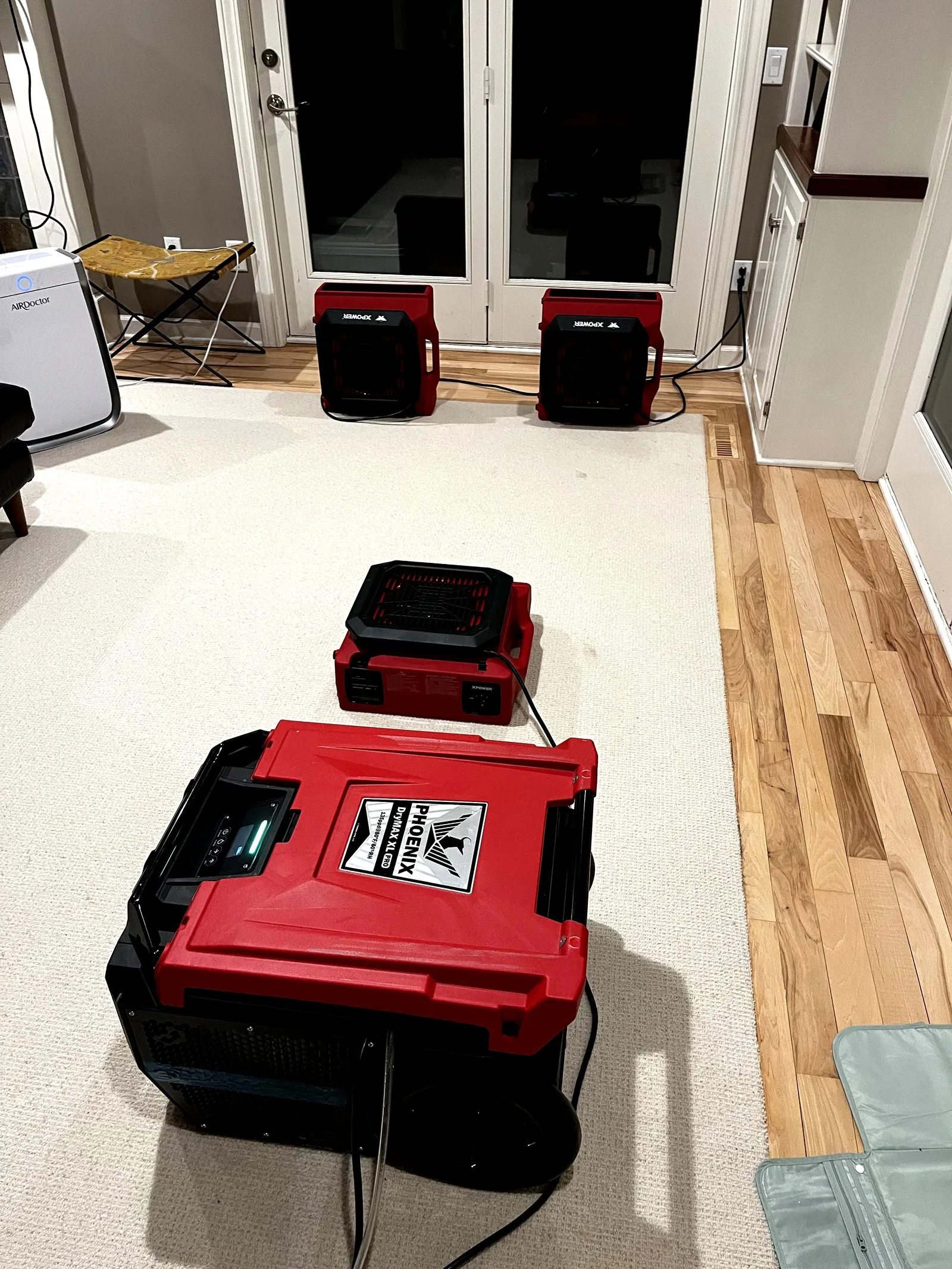 Drying setup, day 2 — Hudsonville sump failure, March 2026
Cut power to the basement, photograph the damage before moving anything, then call a restoration contractor before the plumber. Standard Michigan HO-3 policies do not cover sump pump failure without a Water Back-Up endorsement — that one piece of paperwork is the difference between a $400 deductible and an $11,000 bill.
Most sump pump failures in Grand Rapids do not happen in a thunderstorm. They happen on a calm Tuesday night in March, while you are asleep, after the discharge line outside the foundation freezes solid and the pump cycles itself into thermal shutdown. The first thing you know about it is the sound — a faint sloshing in the basement that does not belong there — and by then the water is already three inches deep against the bottom of the drywall.
This article is what we tell every Grand Rapids homeowner who calls us at 3 AM. Steps in order. The expensive mistakes to avoid. Why insurance probably will not pay. And what the cleanup actually looks like when our crew arrives.
Why Sump Pumps Fail in West Michigan
The pump itself is rarely the problem. We have replaced hundreds of pumps in this county that tested perfectly fine on the bench. The failure point is almost always one step removed from the motor.
West Michigan sits on glacial till and clay-heavy soil. Our water table runs high — especially in the spring snowmelt window from mid-March through late April — and our finished basements are deep. That combination puts a working sump pump under continuous load for weeks at a time. When something gives, it is usually one of these four things:
1. Frozen Discharge Line
Far and away the most common failure we see in Kent and Ottawa counties. The pump runs, water hits the frozen pipe, has nowhere to go, and falls back into the pit. The check valve fails to seal, the pump short-cycles itself into thermal shutdown, and you wake up to a flood. Fix: insulated discharge with a freeze-relief tee, installed before October.
2. Tripped GFCI
A power surge or a moisture splash trips the outlet feeding the pump. The breaker looks fine in the panel because the GFCI is upstream of it. Fix: dedicated circuit, no GFCI on the pump line itself, label clearly.
3. Stuck Float Switch
The tethered float catches on the pit wall, on a piece of debris, or on the discharge pipe itself. The pit fills, the float never rises high enough to trigger the switch, the pump never runs. Fix: vertical float switch with a guard, or a dual-float setup with redundancy.
4. Failed Check Valve
The cheap plastic check valve cracks. Every cycle, the water in the discharge pipe falls back into the pit. The pump runs three times more often than it should and burns out the motor inside 18 months. Fix: spring-loaded brass check valve, $40 part that prevents a $9,000 cleanup.
"In April 2024 we ran 31 sump-related water losses in a single 9-day stretch. The thaw came on hard after a January–February deep freeze and every house with a frozen discharge line failed in the same week. Three of those jobs were customers who had been quoted a battery backup the previous fall and decided to wait. The cheapest of the three came in at $7,400."
The First 60 Minutes, Step by Step
What you do in the first hour determines whether this is a $4,000 cleanup or a $14,000 cleanup. The order is not optional.
Step 1: Cut Power Before You Step in Water
Kill the breakers feeding the basement at the panel. All of them. Outlets, lights, the furnace, the pump itself. Standing water that is touching a live receptacle is an electrocution hazard, not a water loss. We have walked into basements where the homeowner had been wading around for 20 minutes with a live washing machine outlet six inches under the surface. Do not be that homeowner.
Step 2: Document Before You Move Anything
Phone in landscape orientation. Wide shots of every wall — standing in each corner, sweeping across. Then close-ups of any contents touching the floor: cardboard boxes, sectional couches, gym equipment. Then a continuous video walkthrough with audio narration of what you are seeing. Time-stamp everything.
Adjusters pay what you can prove. The single most common reason a water claim gets reduced is that the homeowner moved or threw away contents before they were photographed in place. Document first, salvage second.
Step 3: Stop the Source
Check the discharge pipe outside the foundation. If it is buried in snow or coated in ice, that is your problem — not the pump. Pour warm (not boiling) water on the exit point. If the line was frozen, you will hear the discharge start running within a minute or two of clearing it.
If the discharge is clear and the pump still is not running, check the GFCI outlet, the float switch position, and listen for a hum that indicates the motor is trying but stuck. If you hear nothing, the pump is dead and the next call is to a plumber. But not before the call to us.
Step 4: Call a Restoration Contractor First
This is the one most Grand Rapids homeowners get wrong. Their first call is to a plumber, who arrives in two hours, replaces the pump in 45 minutes, and leaves. Meanwhile the water has been sitting for nearly three hours and is now wicking 18 inches up the drywall.
Restoration first, plumber second. We dispatch a crew on the same call, coordinate the plumber for replacement, and start extraction the moment the floor is electrically safe. The plumber fixes the source. We stop the secondary damage — which is where 80% of your bill lives.
Water rising right now?
Call Ryan directly. Crew dispatched in under 60 minutes across Kent and Ottawa County, 24/7/365.
(616) 822-1978What the Cleanup Actually Looks Like
The IICRC S500 standard governs every step of professional water damage restoration. For a sump pump failure in a finished basement, the typical scope runs five days of equipment time and follows this sequence:
Day 0, Emergency Response
- Extraction: truck-mounted unit pulls 90% of the standing water in the first 90 minutes. We can move 800 gallons per hour with the right equipment.
- Category determination: water from a sump pump pit that backed up is presumed Category 2 minimum — the pit collects soil bacteria from the weeping tile. If a sewer line tied into the pit, it is Category 3 and the scope changes entirely.
- Content manipulation: we move and block furniture out of the affected area. Anything porous and Cat 2 (couches, mattresses, particle-board) gets photographed, inventoried, and disposed.
- Antimicrobial application: EPA-registered product on all wet structural surfaces per IICRC S500 §12.2.4.
- Equipment deployment: typically 6–12 Phoenix Guardian air movers and 1–2 Dri-Eaz LGR 7000XLi dehumidifiers, sized to the cubic footage and the materials affected.
Days 1–4, Drying
- Daily moisture readings on every wet surface using a calibrated penetrating meter
- Daily psychrometric readings (temperature, RH, GPP) to verify the dehumidifier is keeping pace
- Adjustments to airflow and equipment count based on what the readings show
- Drywall flood-cuts where the moisture has wicked above 12 inches — almost always required in finished basements
Day 5, Dry Standard Confirmation
- Every wet material reaches the moisture content of an unaffected reference area in the same building
- Equipment removed only after confirmed dry — not on a predetermined date
- Final psychrometric report with daily logs goes to the carrier as part of the claim package
A "dry" floor that still reads 22% moisture content is a mold farm with a head start. We pull equipment when the meter says so — not when the schedule says so.
Real Numbers from Real Grand Rapids Jobs
| Loss Profile | Square Footage Affected | Total Mitigation Cost |
|---|---|---|
| Unfinished basement, Cat 2, 6-hour sit time | 980 sq ft | $3,247 |
| Finished basement (LVP, drywall, drop ceiling), Cat 2, 14-hour sit | 1,420 sq ft | $11,847 |
| Finished basement w/ sewer-tied pit, Cat 3 biohazard | 1,150 sq ft | $18,920 |
| Walkout basement, Cat 2, finished + framed bath | 1,860 sq ft | $14,632 |
These are mitigation only — extraction, drying, antimicrobial, and demo. Reconstruction (drywall replacement, paint, flooring) is scoped separately once the structure is dry and the carrier has approved the rebuild. We hold a Michigan Residential Builder License (#2101187907), so both phases can run through one contract if you want to skip the handoff.
Insurance, The Part That Catches Everyone
Standard Michigan HO-3 homeowners policies exclude water damage from sump pump failure and sewer backup. The exclusion is buried in the policy under Section I — Exclusions — usually labeled "Water" or "Surface Water." Without an endorsement, your coverage for this specific failure mode is zero.
The endorsement you need is called Water Back-Up and Sump Discharge or Overflow. Names vary slightly by carrier (State Farm calls it "Sewer/Water Backup Coverage," Allstate calls it "Sump and Drain Backup Coverage"), but the function is identical. It typically costs $50–$200 per year and provides $5,000 to $50,000 of coverage.
For a finished basement in West Michigan, our standing recommendation is $25,000 minimum. A typical finished-basement sump failure exceeds the $5,000 default that most carriers offer, leaving you to pay the gap out of pocket.
If you do not know whether you have the endorsement, do not call your agent and ask — that creates a record that you were thinking about it before the loss. Pull your declarations page and look for the line item directly. If it is not there, add it tomorrow. Our full insurance coverage guide walks through every endorsement type and what each one actually pays.
What Most "Cheap" Cleanup Options Actually Cost
The DIY shop-vac approach looks like a $200 weekend project. Here is what it actually runs across Kent and Ottawa County, based on the secondary remediation jobs we are called in on weekly:
(IICRC S500 §12.2.1)
of mold remediation
"dry" to visible mold
shop-vac can reach
Consumer fans and hardware-store dehumidifiers move surface air. They do not pull moisture from inside a 2x4 stud cavity, from below 1/2" plywood subfloor, or from inside fiberglass insulation. The water is still there; you just cannot see it. IICRC S500 §12.2.6 defines structural drying as restoring affected materials to the moisture content of unaffected reference materials — that means meter-verified, not eye-verified.
The Bottom Line for Grand Rapids Homeowners
If your sump pump just failed, the first 60 minutes matter more than anything else you will do in this loss. Cut power, document, stop the source, call a restoration contractor before the plumber. Then check your declarations page for the back-up endorsement — because if you have it, your out-of-pocket is your deductible, and if you do not, the entire bill is yours.
If your pump is currently running fine but you have not had it serviced in three years, this is the article you want to act on before April. Annual sump service in West Michigan runs about $185, and the most expensive sump pump cleanup we ran last year was $22,400 — a 121x return on the maintenance call.
Frequently Asked Questions
Does homeowners insurance cover sump pump failure in Michigan?
Standard Michigan HO-3 policies exclude sump pump failure and sewer backup unless you have a Water Back-Up and Sump Discharge endorsement. Most carriers offer $5,000 to $50,000 in coverage for $50–$200 per year. If you have a finished basement in Kent or Ottawa County and no endorsement, the entire damage is out of pocket.
How much does sump pump failure cleanup cost in Grand Rapids?
$2,800 to $4,800 for an unfinished basement and $7,500 to $14,200 for a finished basement, depending on the category of water and how long it sat. A 2026 finished-basement job in Hudsonville came in at $11,847 — that is the typical range when the pump fails overnight and is discovered in the morning.
How fast does mold grow after a sump pump failure?
IICRC S500 §12.2.1 puts mold colonization at 24 to 48 hours on wet organic materials. In a sealed Grand Rapids basement at 70°F with elevated humidity, we routinely document visible growth at the 36-hour mark. That is why we deploy equipment same-day, not next-business-day.
Should I call a plumber or a restoration company first?
Restoration first. The plumber fixes the pump, but every hour the water sits, the cleanup bill grows. We coordinate the plumber as part of the response and have priority lines into three local plumbers who answer at 2 AM. Calling us first gets both phases moving in parallel.
Why did my sump pump fail if it was only 3 years old?
The pump itself usually is not the failure point. In West Michigan, the most common failures are a frozen discharge line in March, a tripped GFCI outlet, a float switch jammed against the pit wall, and a cracked check valve dumping water back into the pit. We replace pumps weekly that test perfectly fine on the bench.
Will running a shop vac myself save money?
Surface water removal looks cheap until you account for what is still wet inside the wall cavities, under the LVP, and in the insulation behind the drywall. Three weeks later we are called in for mold remediation that runs $4,000 to $8,000 on top of the original loss. The "savings" cost more than the original cleanup would have.