Your stuff after a fire. What actually comes back.
The triage decisions on every contents pack-out — what gets cleaned, what gets thrown out, and how to maximize what your insurance covers.
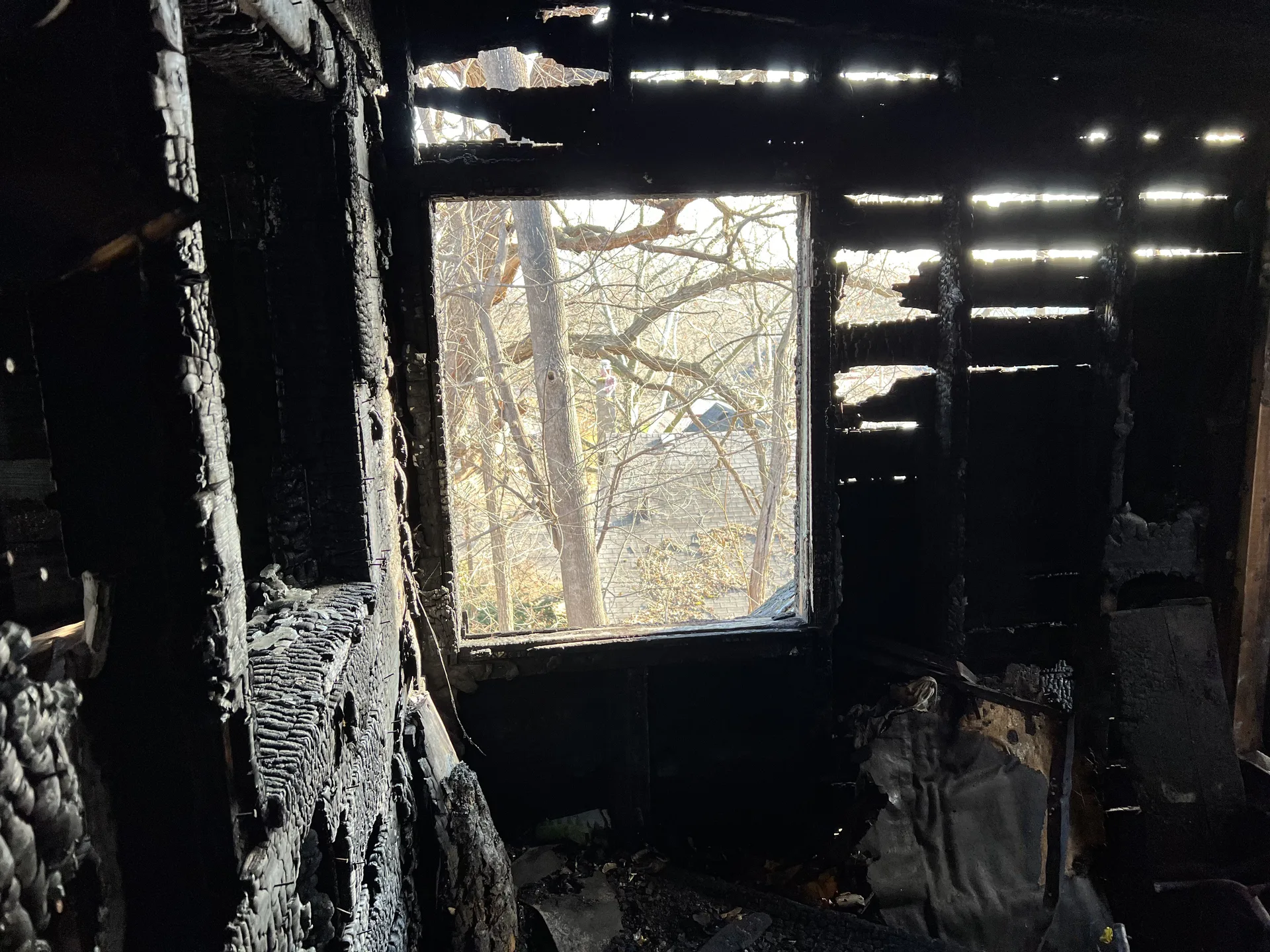 Pack-out inventory in progress — Forest Hills home, post-fire 2025
Hard non-porous items (dishes, glass, metal) almost always survive. Heavy fabrics clean with ozone treatment. Solid wood furniture refinishes. Total losses: foam mattresses, upholstered furniture in heavy-soot zones, plastics near char, paper documents, and anything in direct flame contact.
The day after the fire, the question every homeowner asks is the same: "What about my stuff?" The answer is more nuanced than "everything is ruined" or "we can save it all." Restoration triage works in three buckets — clean, pack-out, total loss — and the bucket each item falls into depends on its material composition, where it was during the fire, and how soot is interacting with its surfaces.
Here is the working triage framework we apply to every fire scene we walk — what we save, what we throw, and how to make sure your insurance covers everything you are entitled to.
The Three Buckets
1. Clean in Place
Items in low-soot zones (typically rooms not directly adjacent to the fire) that can be HEPA-vacuumed and surface-cleaned where they sit. Examples: bookshelves, framed art, light fixtures with minimal deposition, kitchen appliances with surface soot only.
2. Pack-Out for Off-Site Restoration
Items in moderate-to-heavy soot zones that need controlled cleaning environments and specialized equipment. Pack-out moves the items to a restoration facility where they are inventoried, photographed, cleaned with the right method (ultrasonic, ozone, hydroxyl, hand cleaning), stored in clean conditions, and returned after structural reconstruction completes.
3. Total Loss / Disposal
Items that cannot be safely or economically restored. These are inventoried, photographed, valued for the contents claim, and disposed. The insurance carrier needs the inventory and valuation to pay the contents portion of your claim.
What Survives by Material Type
| Material | Light Soot Zone | Heavy Soot Zone | Char Zone |
|---|---|---|---|
| Dishes / glass / metal | Clean in place | Pack-out, ultrasonic clean | Pack-out (verify integrity) |
| Solid wood furniture | HEPA + clean | Pack-out + refinish | Often total loss |
| Upholstered furniture | HEPA + clean | Total loss (foam absorbs odor) | Total loss |
| Mattresses (foam) | Often total loss | Total loss | Total loss |
| Mattresses (innerspring + cover) | Pack-out, ozone | Total loss | Total loss |
| Clothing / linens | Specialty laundering | Specialty laundering + ozone | Often total loss |
| Books / paper documents | Document recovery service | Total loss for most | Total loss |
| Electronics (powered off) | Specialist cleaning | Specialist evaluation | Total loss |
| Electronics (powered on) | Often total loss | Total loss | Total loss |
| Plastic items | Surface clean | Total loss (absorb odor) | Total loss |
| Photographs (analog) | Photo restoration service | Photo restoration service | Total loss |
"After a 2025 Wyoming MI house fire, the homeowner was certain her grandmother's china was destroyed. The fire room was in the kitchen, and the dining room was 8 feet away with heavy soot deposit. Pack-out and ultrasonic cleaning recovered every piece of the china set unbroken. Cost: $1,840 of pack-out service. Replacement value the carrier would have paid: roughly $4,200. The china set is irreplaceable to her either way."
How Pack-Out Actually Works
The day after the fire, the contents crew arrives with inventory tablets, packing materials, and a moving truck. The process:
- Walk the home with the homeowner — identify items the homeowner wants prioritized (jewelry, irreplaceable photos, work documents). Set those aside for immediate hand-off if possible.
- Inventory each item — photo, tag, room of origin, description, condition note. Standard restoration software (Encircle, Xactimate Contents) generates the manifest.
- Pack and transport — bubble wrap, pads, hard cases for fragile items. Loaded into climate-controlled vehicles to prevent further damage in transit.
- Off-site cleaning — ultrasonic baths for hard goods, ozone chambers for textiles, hand cleaning for delicates, electronics handed to specialty subcontractors.
- Storage — cleaned items kept in dry, climate-controlled storage until home reconstruction completes.
- Return delivery — inventoried back into the home with the homeowner present to verify against the original manifest.
The single most expensive contents mistake is throwing things away before pack-out. Once the dumpster goes, those items become "estimated value" instead of "documented value" on the claim.
Insurance — Replacement Cost vs. Actual Cash Value
Most Michigan HO-3 policies cover contents at actual cash value (ACV) by default, which is replacement cost minus depreciation. For an 8-year-old couch, ACV might be 40–50% of new replacement cost.
If you have replacement cost coverage (an upgrade endorsement on most policies), the carrier pays ACV up front and the depreciation portion releases when you submit receipts proving you actually replaced the item. The replacement cost endorsement typically adds 5–15% to your annual contents premium and is worth it for any household with significant furniture, electronics, or appliances.
For high-value items (jewelry above the standard sublimit, fine art, collectibles, firearms), scheduled personal property riders provide individual valuation and lower deductibles per item. Without scheduling, most policies cap jewelry at $1,500 and fine art at $2,500 regardless of actual value.
Documentation — What to Photograph Before You Touch Anything
Same rule as water damage. Document first, move second.
- Wide shots of every room before any contents are moved
- Close-ups of any visibly damaged items, with reference object for scale
- Inventory of high-value items (electronics serial numbers, jewelry photographs, fine art with provenance)
- Receipts and credit card statements for items purchased in the last 5 years
- Pre-loss photos from family albums, real estate listings, social media — pull anything that shows the items in their pre-loss condition
Need a contents pack-out?
Call within 48 hours — faster pack-out preserves more contents value for your claim.
(616) 822-1978Frequently Asked Questions
What contents survive a house fire?
Hard non-porous items (dishes, glass, metal, sealed ceramics) almost always survive. Heavy fabrics and clothing usually clean with ozone or hydroxyl treatment. Solid wood furniture often refinishes. Total losses: foam mattresses, upholstered furniture in heavy-soot zones, plastic items near char zones, paper documents, and anything within direct flame contact.
What is a fire restoration pack-out?
A pack-out is the inventoried removal of salvageable contents from a fire-damaged home to a controlled cleaning facility. Each item is photographed, tagged, and logged. Cleaning happens off-site with proper equipment, and items return after the home is rebuilt.
Are my electronics ruined after a house fire?
Possibly salvageable depending on power state during the fire and soot deposition level. Electronics that were powered off during the fire and have only surface soot can be professionally cleaned. Items powered on, or with internal soot showing through vents, are usually total losses due to acidic corrosion.
How do I prove what I owned for the insurance contents claim?
Pre-loss photos, receipts, credit card statements, and any home inventory. For items you can't prove, your contractor's pack-out documentation and standard depreciation schedules become the basis for valuation.
How long does contents restoration take after a fire?
Hard goods cleaning: 1–2 weeks. Textile and clothing restoration: 2–4 weeks. Solid wood furniture refinishing: 4–8 weeks. Electronics restoration: 2–6 weeks. Runs in parallel with structural reconstruction.