Soot can be cleaned. Char gets demoed.
The single most important distinction in fire restoration scoping — and the line that determines whether your bill is $8,000 or $80,000.
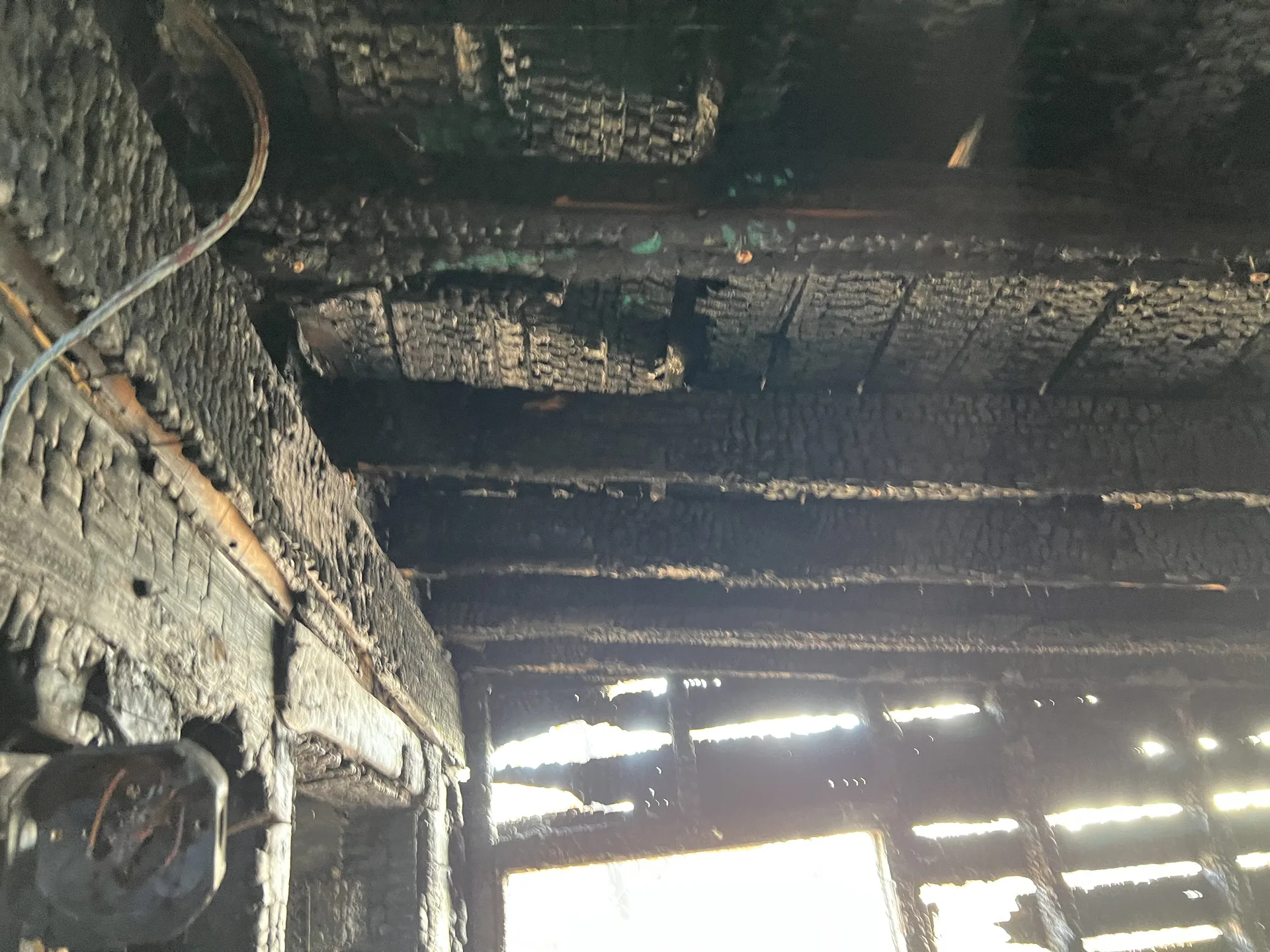 Char zone (left) vs. soot zone (right) — same wall, two different scopes
Soot is surface deposit from smoke and can be cleaned off most materials. Char is structural carbonization of the substrate itself and the material must be removed. Every fire restoration scope is built on this distinction — and the line between them is usually 4 to 6 feet from the ignition point.
When we walk a fire scene with a homeowner, the first question is always the same: "How much of this is going to have to come out?" The answer is determined by where soot ends and char begins. That line, drawn correctly, can mean the difference between an $8,000 cleanup and an $80,000 reconstruction.
This article is the working definition we use in the field, why it matters for both restoration scope and insurance valuation, and how to read your own fire scene before the contractor arrives.
Soot — What It Is and What Happens to It
Soot is the visible carbonaceous deposit smoke leaves on surfaces. It is composed of microscopic particles — 0.1 to 4 microns — produced by incomplete combustion of whatever was burning. The particles are electrostatically charged, which is why they cling to surfaces (especially cool surfaces and corners) and why they accumulate inside electronics that were running during the fire.
Soot does not damage the underlying material if removed in time. A drywall ceiling with heavy soot deposit is structurally identical to one without — the difference is purely cosmetic. Per IICRC S700, surface soot can be cleaned from:
- Hard non-porous (tile, glass, sealed metal): 95%+ recovery with appropriate cleaner
- Sealed porous (painted drywall, finished wood): 80–95% recovery
- Unsealed porous (raw wood, drywall paper, fabric): 60–90% depending on saturation level
- Heavily porous (carpet padding, fiberglass insulation, attic dust): generally not recoverable, removal recommended
The age of the deposit matters. Acidic byproducts in soot will etch and discolor surfaces over weeks if not removed. A 24-hour soot deposit on chrome plumbing fixtures cleans cleanly; a 90-day deposit leaves permanent etching. This is why we deploy on fire scenes within hours, not days.
Char — What It Is and Why It Has to Go
Char is the carbonized residue produced when an organic material is exposed to direct flame or intense radiant heat. The material's cellular structure has been thermally decomposed. The pre-stage is pyrolysis — heat decomposition without sufficient oxygen for ignition. A pyrolyzed wood stud may show no visible char yet and still be structurally compromised because the cellulose has been driven out.
Char and pyrolyzed substrate are removed for three reasons:
- Structural integrity — charred lumber loses load-bearing capacity progressively. Building code requires replacement of any charred structural member.
- Continued odor source — carbonized substrate continues to off-gas VOCs for months. Sealing alone is insufficient when the substrate itself is the source.
- Re-ignition risk — deeply pyrolyzed wood can smolder for hours after the fire is "out" if oxygen reaches it. Any wood with internal pyrolysis is removed and disposed.
The depth-of-char rule of thumb in framing lumber: every 1/16" of visible char represents approximately 1/4" of structurally compromised wood behind it. A 2x4 with 1/8" of visible char has lost roughly 1/2" of effective cross-section — meaningful structural reduction.
"On a 2025 Forest Hills basement fire, the homeowner's first contractor wanted to clean and repaint the joists 'because they look fine.' I pulled out a chisel and tested three of them — the surface looked clean but the inner 3/8" of each was carbonized. Reframing those joists added $14,200 to the scope, but we did not deliver him a basement that would smell of smoke every summer for the next decade."
How We Read a Fire Scene
The standard sequence on initial assessment:
1. Identify the ignition point
The center of the highest heat damage. Char is most severe here, usually with a "V" pattern on the wall above.
2. Map the char zone
Walk outward from the ignition point. Char typically extends 4–6 feet horizontally before transitioning to surface scorch (still demo) and then to heavy soot (cleanable). Above the ignition point, char extends to the ceiling and across to the next vertical surface.
3. Test pyrolysis on perimeter materials
Wood at the char/soot transition gets a chisel test. If the surface chips reveal carbonized wood beneath, the demo zone extends. If the wood beneath is normal-colored cellulose, the surface can be cleaned and sealed.
4. Map smoke deposition through the rest of the house
Soot follows the convection currents the fire created. We map deposition with chemical sponge tests and visual inspection of corners, ceilings, and HVAC supply registers.
5. Assess HVAC contamination
Pull a return register and inspect the duct. Soot inside the duct system means whole-house cleaning, not just the fire room.
The quote you get from a contractor who skips the chisel test will be lower — and the smell of smoke in your house in three years will be his problem to no longer worry about.
Materials by Type — Clean or Demo
| Material | Surface Soot | Heavy Soot | Char / Pyrolysis |
|---|---|---|---|
| Painted drywall | Clean | Clean (multiple passes) | Demo |
| Wood framing | Clean & seal | Sand & seal | Demo + replace |
| Carpet | HEPA + steam | Demo | Demo |
| Carpet padding | Demo | Demo | Demo |
| Fiberglass insulation | Demo | Demo | Demo |
| Solid wood furniture | Clean & refinish | Refinish or refer to subcontractor | Demo |
| Electronics | HEPA-vacuum vents, may need professional cleaning | Usually replaced | Replaced |
| HVAC ductwork | NADCA cleaning | NADCA cleaning | Replace affected sections |
| Attic insulation (blown) | Often replaced | Replaced | Replaced |
Why Insurance Cares About This Distinction
Adjusters scope fire claims using IICRC S700 standards in Xactimate. Cleaning categories (soot) and removal categories (char) carry different price codes. An adjuster who looks at a wall and writes "clean and repaint" when the actual scope is "demo and reframe" leaves significant money on the table. Conversely, contractors who claim demo on materials that are actually salvageable get challenged.
Documentation is the defense in either direction. We photograph every char/soot transition with a measuring tape in the frame and submit chisel-test photos showing pyrolysis depth. The carrier sees the evidence, the scope holds.
Just had a fire?
Don't start cleaning yet — the wrong cleaning method drives soot deeper. Call us first.
(616) 822-1978Frequently Asked Questions
What is the difference between soot and char?
Soot is carbonaceous particulate deposited on surfaces by smoke. It can be cleaned. Char is structural carbonization of the substrate itself caused by direct fire contact or intense radiant heat. Char is permanent and the material must be removed.
Can a charred 2x4 stud be sanded back to clean wood?
No. Char penetrates the wood structurally and weakens the lumber's load-bearing capacity. Even if you sand to visually clean wood, the fibers behind the surface have lost cellulose and are structurally compromised.
Why does my drywall have black streaks even outside the fire room?
Smoke webs. The fire's convection currents carry soot particles long distances and they accumulate on cool ceiling surfaces and in corners away from the fire.
How do contractors decide what gets cleaned vs. demoed?
IICRC S700 §10 plus visual and tactile assessment. Surface soot on hard non-porous surfaces cleans easily. Soot on porous surfaces cleans with 70-90% recovery. Char on any material is removed.
Will I have to demo my whole house after a kitchen fire?
Probably not. A typical contained kitchen fire damages cabinets and adjacent drywall directly (char zone, demoed) and deposits soot throughout the house (cleaned). Demo scope follows char, not smoke.