The smell isn’t a smell. It’s microscopic soot.
Why every Michigan homeowner who tries to DIY smoke odor removal ends up with the smell back by July — and what professional fire restoration actually does about it.
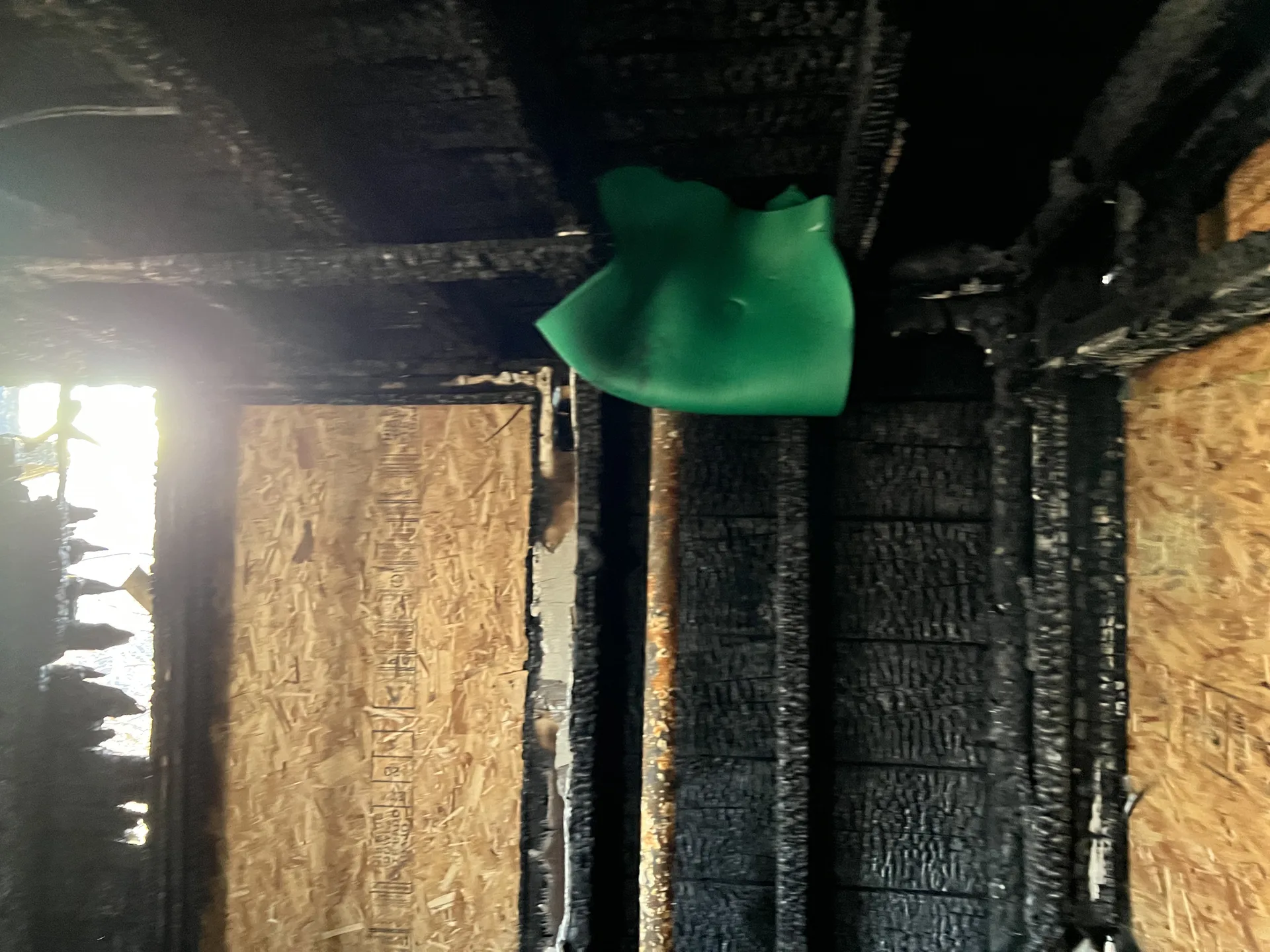 Smoke residue, day 1 — kitchen fire aftermath, Wyoming MI
Smoke odor is microscopic soot particles embedded inside porous materials — drywall, insulation, carpet pad, HVAC ducts, attic dust. Surface cleaning removes 30–40% of the residue. The rest is reactivated by Michigan summer humidity, which is why DIY smoke odor always comes back.
Smoke odor is the most misunderstood part of fire restoration. Homeowners think of it as a smell — something that can be masked, sprayed over, or "aired out." It is not. It is a physical residue: microscopic soot particles produced by combustion, electrically charged so they cling to surfaces, small enough to penetrate the pores in drywall paper, paint, fabric, wood, and insulation.
The reason every consumer-grade approach fails is that it addresses what you can smell, not what is producing the smell. The source material has to be either removed or chemically treated to neutralize the soot itself. Until then, the next time the indoor humidity rises — which in West Michigan is every summer — the smell comes back. We get the call on those jobs every July: "We thought we got rid of it last spring, and now it's back."
What Smoke Residue Actually Is
Per IICRC S700, smoke residue contains:
- Particulate carbon (soot) — visible black/grey deposit, electrostatically charged
- Volatile organic compounds (VOCs) — what your nose actually smells
- Polycyclic aromatic hydrocarbons (PAHs) — carcinogenic compounds from incomplete combustion
- Acidic byproducts — corrode metals and electronics over time
- Plastic combustion residue — from synthetic materials, often the strongest odor source
Particle sizes range from 0.1 to 4 microns — small enough to penetrate the porous structure of drywall paint, the fibers in carpet and upholstery, and the cellulose in attic insulation. A standard cleaning cloth and bottle of all-purpose cleaner addresses the surface deposit and leaves the substrate-embedded portion completely alone.
The Three Smoke Types — Each Needs Different Treatment
1. Wet Smoke (low-heat, slow-burn fires)
From smoldering plastics, rubber, foam furniture. Sticky, smeary residue. Strongest odor of the three. Hardest to clean — smearing during attempted cleaning embeds the residue deeper into surfaces. Requires solvent-based cleaners and often abrasion before chemical treatment.
2. Dry Smoke (high-temp, fast-burn fires)
From paper, wood, and other cellulosic materials. Powdery residue. Brushes off cleanly from non-porous surfaces but penetrates porous materials deeply. Treatable with HEPA vacuuming followed by alkaline degreaser cleaning.
3. Protein Smoke (kitchen fires)
From burned food. Almost invisible deposit (light yellow film) but extreme odor. Affects every porous surface in the home regardless of distance from the fire source. Requires specialized enzyme cleaners because the residue is organic and re-aerosolizes when warmed. The "I had a small grease fire on the stove and now my whole house smells" problem is almost always protein smoke.
"In November 2025 a Caledonia homeowner had a 90-second grease fire on her stove. No flames extended past the range hood. She spent three weekends cleaning with bleach, vinegar, ozone candles, and a $400 air purifier from Costco. By February the smell was back stronger than ever. We tested the HVAC ductwork — protein smoke residue throughout the supply trunk. Total remediation: $5,840 with full duct cleaning and thermal fogging."
Why Each DIY Method Fails
| Method | What It Does | Why It Fails |
|---|---|---|
| Bleach + cleaning surfaces | Removes surface deposit only | Doesn’t reach embedded particles in porous materials |
| Febreze / odor sprays | Masks odor temporarily | VOCs continue to off-gas; smell returns within days |
| Ozone candles / air freshener plugs | Adds competing scent | Same as Febreze, with added respiratory irritation |
| Consumer ozone generator | Destroys airborne odor molecules | Can’t penetrate substrate; damages rubber HVAC parts |
| HEPA air purifier | Filters airborne particles | Doesn’t address the embedded source — smell returns when off |
| Painting over walls | Seals visible soot temporarily | Without odor-blocking primer, VOCs penetrate the new paint within weeks |
| Replacing carpet only | Removes biggest porous surface | HVAC ducts, drywall, insulation still hold the residue |
If your smoke remediation does not include HVAC cleaning, attic dust assessment, and substrate treatment of every porous surface in the affected zone, it will fail by August.
What Professional Smoke Remediation Actually Does
1. Source Removal
Severely contaminated materials are removed entirely. For a kitchen fire: damaged cabinets, charred drywall, scorched insulation. For a structural fire: anything with visible char or soot saturation in porous materials.
2. HEPA Vacuuming
Every surface in the affected area — walls, ceilings, attic deck, baseboards, light fixtures, register grilles, contents. HEPA capture (down to 0.3 micron) prevents the soot we lift from being redeposited elsewhere. This is not a vacuum-the-carpet operation; it is a comprehensive surface decontamination.
3. Substrate Cleaning
Method matched to smoke type. Wet smoke gets solvent-based cleaning. Dry smoke gets alkaline degreaser. Protein smoke gets enzyme cleaners. Multiple passes on heavily affected surfaces.
4. HVAC Decontamination
Soot enters the supply ducts in the first 30 seconds of any fire event and redistributes throughout the house. Professional duct cleaning per NADCA standards — mechanical agitation plus HEPA-filtered negative-air collection — is non-negotiable for any smoke remediation that is supposed to last. Skip this step and the smell comes back in summer.
5. Odor Neutralization
For residual odor after substrate cleaning:
- Thermal fogging — vaporized petroleum-based deodorizer that penetrates the same pathways smoke took to enter materials. Most effective for wet and protein smoke.
- Hydroxyl generation — safer for occupied spaces, breaks down VOC molecules without ozone’s side effects.
- Ozone generation — only when the home is unoccupied; effective for dry smoke and lingering odor in sealed spaces.
6. Sealing
Affected wood framing (studs, joists), subfloor, attic deck sealed with odor-blocking primer (Kilz Original Oil-Base, BIN Shellac, or commercial equivalent) before reconstruction begins. This locks any residual VOCs into the substrate permanently.
7. Final Air Sample
Independent lab analysis of indoor air for particulate counts and VOC concentration vs. an outdoor control. Reoccupation cleared only when the indoor reading matches normal indoor baseline.
Smoke event in your home?
Do not start cleaning yet — the way you clean determines whether the odor comes back. Call us first.
(616) 822-1978The Insurance Side
Smoke damage is covered under standard Michigan HO-3 policies as long as the source event is a covered peril (kitchen fire, electrical short, neighboring structure fire venting into yours, etc.). The carrier requires documentation:
- Photos of soot deposition on walls and ceilings (often visible only at corners and on light-colored surfaces)
- Surface testing for soot particulate (we use chemical sponges and lift samples for lab confirmation)
- Source identification — a fire department report if the fire department was called
- HVAC inspection demonstrating contamination of the duct system
Smoke-only claims (no structural fire damage) are sometimes denied as cosmetic. Documentation showing measurable soot levels and HVAC contamination converts these from cosmetic to remediable. We provide that documentation as part of our standard scope.
Frequently Asked Questions
Why does smoke odor come back after I clean?
Surface cleaning removes 30-40% of smoke residue. The remaining 60-70% is embedded in porous materials — drywall paper, carpet padding, insulation, HVAC ductwork, attic dust. Heat and humidity reactivate the odor by re-volatilizing the embedded particles.
Do ozone generators work for smoke odor?
Ozone destroys odor molecules in the air, not in the substrate. It works on surface odors temporarily but does not penetrate drywall, upholstery, or insulation. Hydroxyl generators are safer and more effective for occupied spaces but still require source removal first.
How much does professional smoke odor removal cost?
Single-room smoke remediation runs $1,800 to $3,400. Whole-house smoke from a kitchen fire (no structural damage) runs $4,200 to $8,500. Whole-house from a structural fire is bundled into the fire restoration scope, typically $20,000 to $80,000+.
Will my insurance cover smoke odor cleanup if I had no fire damage?
Yes if the smoke event came from a covered peril — kitchen grease fire, electrical short, neighboring structure fire that vented into your home. The coverage is for the loss of use of materials damaged by smoke, not just the smell.
How long does smoke odor remediation take?
Single-room smoke remediation typically takes 3 to 5 days: HEPA cleaning (day 1), thermal fogging or hydroxyl treatment (days 2-3), HVAC cleaning (day 4), final inspection (day 5). Whole-house events run 1 to 2 weeks.