Category 3 sewage isn’t just water. It’s a public-health event.
What is actually in sewage backup, why the IICRC S500 standard requires us to remove every porous material in the affected zone, and the math behind why DIY cleanup costs more than the original loss.
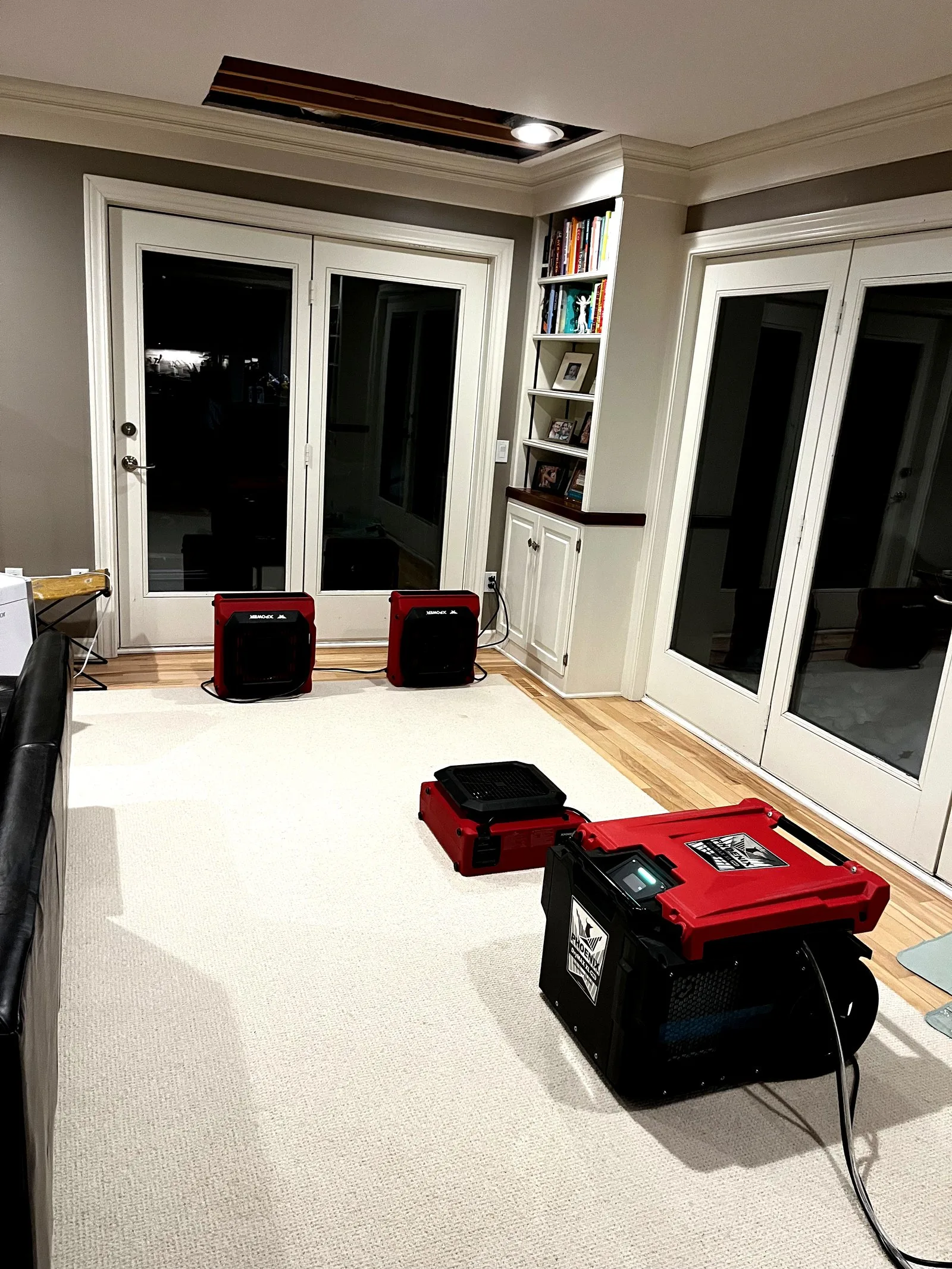 Cat 3 containment setup — Comstock Park sewer backup, March 2026
Category 3 water (sewage, toilet overflow past the trap, rising flood, any water sitting 48+ hours) carries E. coli, Hepatitis A, norovirus, Giardia, and other pathogens that survive on dry surfaces for weeks. IICRC S500 §12.2.5 requires removal of every porous material in the affected zone — not surface cleaning.
The reason a Category 3 sewage cleanup costs three to five times what a Category 1 clean-water loss costs is not the volume of water. It is what the water carries and where it goes after you stop seeing it. The IICRC S500 standard treats sewage backup as a public-health event because that is what it actually is — and the math on cleaning it correctly is built around pathogens, not aesthetics.
This is the article we wish every Grand Rapids homeowner had read before deciding whether to call us or rent a wet-vac. Skim the pathogen list before you make that call.
What Category 3 Water Actually Is
Per IICRC S500 §10.5.3, Category 3 water is "grossly contaminated and can contain pathogenic, toxigenic or other harmful agents and can cause significant adverse reactions to humans if contacted or consumed." That includes:
- Sewage backup from the municipal main or septic system
- Toilet overflow from beyond the trap
- Rising floodwater from rivers or storm runoff
- Wind-driven rain that picks up surface contaminants
- Any Category 1 or 2 water that has sat untreated for 48+ hours (including burst pipes ignored over a long weekend)
That last bullet trips up more homeowners than any other. A clean-water leak that started Friday night and is discovered Monday morning is no longer a clean-water loss. The IICRC standard reclassifies it because bacterial growth in stagnant water at room temperature crosses the contamination threshold by hour 48.
The Pathogen List
Sewage backup water in West Michigan typically tests positive for the following organisms. The numbers in parentheses are how long each one survives on a dry, indoor surface at room temperature:
| Pathogen | Causes | Surface Survival |
|---|---|---|
| E. coli (incl. O157:H7) | Severe GI illness, kidney failure | up to 28 days |
| Salmonella | Gastroenteritis, typhoid | up to 4 weeks |
| Hepatitis A virus | Acute liver disease | up to 60 days |
| Norovirus | Severe vomiting / diarrhea | 2–4 weeks (some strains 6+) |
| Rotavirus | Severe pediatric GI illness | up to 60 days |
| Giardia & Cryptosporidium | Chronic GI parasitic illness | weeks to months in moist material |
| Shigella | Dysentery | several days to weeks |
The Hepatitis A and norovirus survival numbers are the ones most people do not know about. A "dry" floor where sewage water passed three weeks ago can still infect a child who crawls across it. That is why IICRC standards do not allow drying-in-place for Cat 3 losses — the contamination embeds in porous materials at depths surface disinfection cannot reach.
"In summer 2024 we ran a Cat 3 cleanup in Wyoming MI where the homeowner had cleaned up an earlier backup himself with bleach and a wet-vac. ATP testing on the 'cleaned' carpet pad showed 4,200 RLU — well above the 30 RLU threshold for sanitized surfaces. The pad was visibly dry. The contamination was a half-inch below the surface where bleach never reached."
Why IICRC S500 Mandates Material Removal (Not Cleaning)
For a Cat 1 or Cat 2 loss, drying-in-place is allowed for many porous materials because the contamination level is low and the materials can be sanitized in place. For Cat 3, that option does not exist.
IICRC S500 §12.2.5.4 requires:
- Carpet: remove and discard. No exceptions for Cat 3.
- Carpet pad: remove and discard.
- Drywall: remove minimum 24 inches above the highest wet line, plus all wet insulation behind it.
- Baseboards / shoe molding: remove if affected.
- Engineered hardwood / laminate: remove. Solid hardwood may be assessed case-by-case but typically removed.
- Subfloor (OSB / particleboard): remove if delaminated; assess sand/seal options on plywood.
- Cabinetry kick panels: remove or cut to expose the cavity.
- Upholstered furniture, mattresses: remove and discard.
This is not us being aggressive. It is the standard. Any restoration company that tells you they can dry your Cat 3 carpet in place is either uncertified or willing to expose your family to a documented infection risk to keep their bid low.
The Containment Setup
Before any demo begins, we set the work zone up to keep contamination from spreading to the rest of the house:
- 6-mil polyethylene containment with double-zip entry from the affected area to the rest of the house, sealed to floor and ceiling
- Negative-air HEPA scrubber (typically 500 CFM units, sized to the cubic footage) running 24/7, exhausted to outside
- HVAC isolation — supply and return registers in the affected zone sealed off so contaminated air does not get pulled into ducts
- PPE for all crew — Tyvek suit, P100 respirator, nitrile gloves under chemical gloves, rubber boots, eye protection per OSHA bloodborne pathogen standards
- Decontamination chamber at the entry/exit point with anti-microbial spray and disposable boot covers
If your contractor walks into a sewage cleanup wearing jeans and a polo shirt, they are not following the standard. The standard is bunny suits and respirators — not because we are being dramatic, but because the standard is written for a reason.
The Cleanup Sequence
Day 0 — Containment, Extraction, and Demo
Containment goes up first. Then truck-mount extraction pulls the standing water. Then the demo of all porous materials per the S500 list above — bagged in 6-mil contractor bags, taped, and removed via the contained pathway. Hard surfaces (concrete, tile, sealed flooring) are scraped clean and HEPA-vacuumed. EPA-registered hospital-grade antimicrobial applied to every surface. Photos at every step for the carrier.
Days 1–3 — Drying with Containment Maintained
Phoenix Guardian air movers and Dri-Eaz LGR dehumidifiers placed inside the containment. HEPA scrubber continues to run. Daily moisture readings on remaining structural materials. Second antimicrobial pass once surfaces are dry.
Day 4–5 — Post-Remediation Verification
This is where we differ from contractors who "just want to be done." We pull ATP bioluminescence swabs on every previously contaminated surface. Threshold for clearance is 30 RLU (sanitized) on food-contact surfaces, 100 RLU on general structural surfaces. We also send air samples to EMSL Analytical or Summit Environmental for total bacterial count and pathogen-specific PCR if the loss involved sewage from the sanitary side. We provide the lab report to the carrier and to you.
Reconstruction
Only begins after PRV passes. Drywall, insulation, flooring, baseboard, paint per the original specs. Builder License #2101187907 covers both the mitigation and the rebuild — one contract, one point of contact.
Real Costs from Real Grand Rapids Cat 3 Jobs (2025–26)
| Loss Profile | Affected Area | Total Mitigation Cost |
|---|---|---|
| Toilet overflow past the trap, finished bath | 180 sq ft | $4,820 |
| Sewer main backup, unfinished basement | 820 sq ft | $8,140 |
| Sewer main backup, finished basement | 1,150 sq ft | $19,840 |
| Septic field failure, walkout finished basement | 1,640 sq ft | $27,420 |
| Cat 1 leak left 6 days, reclassified Cat 3 | 620 sq ft | $11,290 |
Insurance — the Same Story as Sump Pump
Standard Michigan HO-3 policies exclude sewage backup. The same Water Back-Up and Sump Discharge endorsement that covers sump pump failure also covers sewer backup — same endorsement, same coverage limit. The default $5,000 cap is almost never enough for a finished-basement Cat 3 loss. We recommend a minimum of $25,000 of coverage for any house with a finished basement in Kent or Ottawa County.
If you are reading this in the middle of an active sewage backup, your endorsement question is the second call you make. The first call is to us.
Active sewage backup right now?
Do not wade into it. Call us before you touch anything. Containment-first response from a Cat 3 certified crew, 24/7/365.
(616) 822-1978The DIY Math Nobody Does
Renting a wet-vac and a couple of bottles of bleach feels like a $250 weekend. Here is what actually happens, in the order it happens:
- Surface water removed in 4–6 hours of work. Looks clean.
- Bleach applied to visible surfaces. Smells "sanitized."
- Carpet pad still wet underneath. Bacteria still present below the surface bleach can reach.
- Within 7–14 days, mold begins colonizing the wet pad. Smell starts.
- Within 30 days, residual pathogens in the wall cavity behind drywall create a low-level air contamination signal.
- Family members report unexplained GI symptoms, allergic reactions, or asthma flare-ups.
- Restoration company called for "mystery odor / illness." They open the wall and find a colonized cavity.
- Full Cat 3 remediation now required, plus mold remediation, plus the cost of the original DIY supplies. Bill: $14,000–$22,000.
The original professional Cat 3 cleanup would have been $8,000–$15,000. The "savings" cost more than the proper job, and the family was exposed to bacterial and mold contamination for 30+ days in the meantime.
Frequently Asked Questions
What makes sewage backup a Category 3 loss?
IICRC S500 §10.5.3 classifies any water containing significant biological contamination as Category 3, including sewage, toilet overflows from beyond the trap, rising floodwater, and any Category 1 or 2 water that has sat untreated for 48+ hours. Category 3 water is presumed to contain bacteria, viruses, and protozoa harmful to humans.
What pathogens are in sewage backup water?
Sewage backup commonly contains E. coli, Salmonella, Hepatitis A, norovirus, rotavirus, Giardia, Cryptosporidium, and the bacteria responsible for shigellosis. Hepatitis A virus survives on dry surfaces for weeks. Some norovirus strains remain infectious for over a month. This is why IICRC S500 requires complete removal of porous materials, not surface cleaning.
Can I clean up a small sewage backup myself?
Not safely. The contamination invisible to the eye is the dangerous part. Aerosolized pathogens travel through HVAC systems and contaminate areas you never knew were affected. Even with bleach and PPE, DIY cleanup leaves bacteria embedded in sub-surface materials. Insurance will not pay for it, and a future buyer's home inspection often catches the residual contamination.
How much does Category 3 sewage cleanup cost in Grand Rapids?
Cat 3 sewage cleanup runs $4,800 to $8,200 for unfinished basements (under 600 sq ft affected) and $12,000 to $28,000+ for finished basements with full drywall and flooring removal. The cost difference vs. Cat 1 is driven by mandatory porous material disposal and biohazard manifests, not by the water volume.
Does insurance cover sewage backup in Michigan?
Standard HO-3 policies exclude sewage backup. You need a Water Back-Up and Sump Discharge endorsement, typically $50–$200 per year for $5,000–$50,000 of coverage. Most West Michigan homeowners we serve have the minimum $5,000 default, which rarely covers a finished-basement sewage loss. We recommend $25,000 minimum if you have a finished basement.
How long until I can use the basement again after sewage cleanup?
Reentry after professional Cat 3 cleanup typically takes 5 to 7 days: extraction and demo (day 1), antimicrobial cycles (days 1–2), structural drying (days 2–4), post-remediation verification with ATP swabs and air samples (day 5), then reconstruction. We do not clear a Cat 3 space until ATP readings drop below 30 RLU on every previously affected surface.