Why your Grand Rapids basement actually floods.
Four causes, four insurance outcomes, and the restoration playbook for each. The version we wish every West Michigan homeowner had read before the first call.
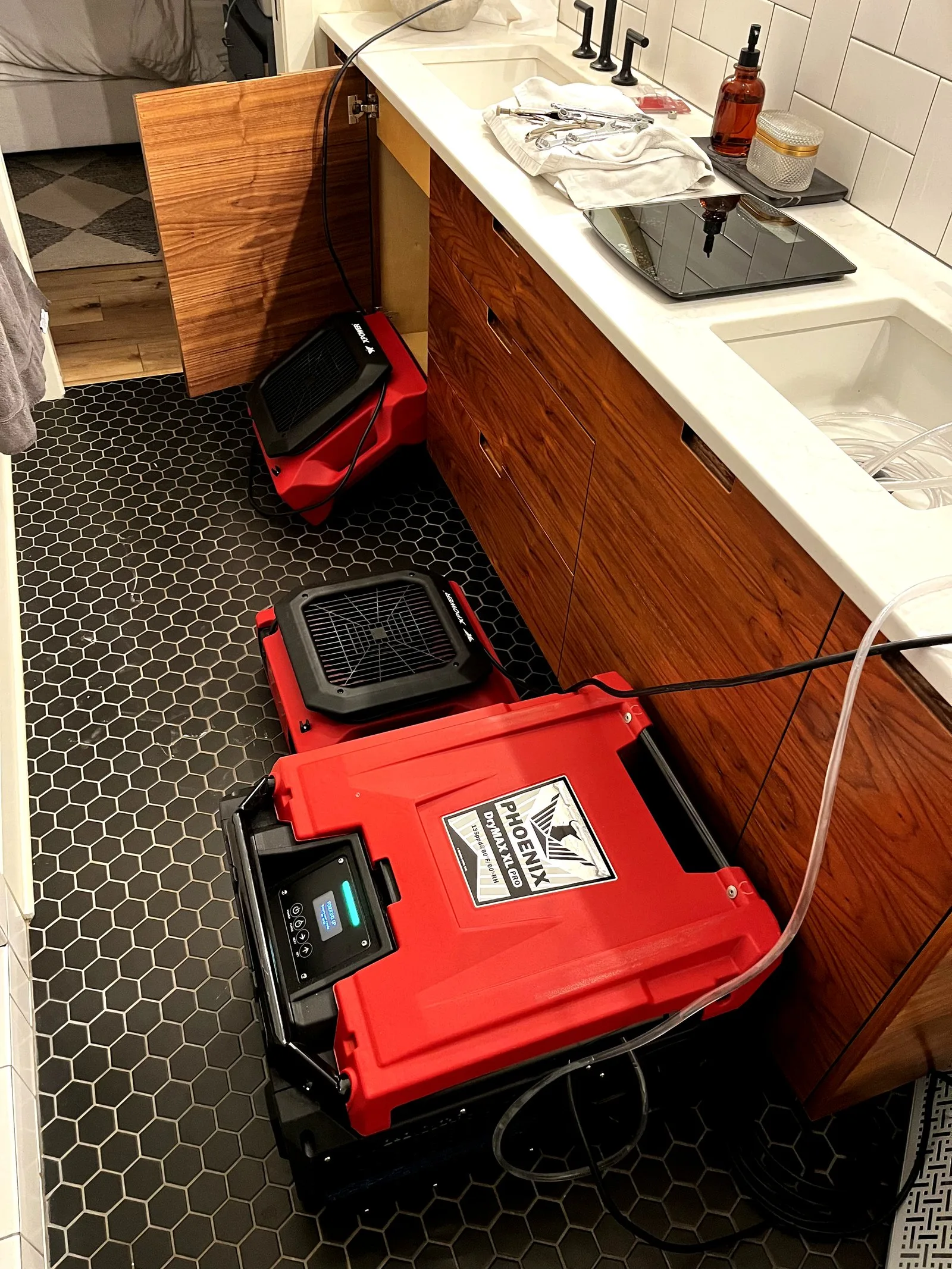 Active drying setup — Walker basement, post-thaw flood March 2026
Four causes account for almost every Grand Rapids basement flood: sump pump failure, sewer backup, foundation seepage during heavy spring rain, and burst supply lines. Each has a different insurance outcome — and only burst pipes are covered under a standard HO-3 policy without an endorsement.
Every basement flood we respond to in Kent and Ottawa County traces back to one of four causes. The water looks the same when you walk down the stairs at 7 AM, but the cause determines three things: who pays, how fast we have to move, and what category the IICRC standard requires us to treat it as. Get the cause wrong and you start the wrong cleanup, fight the wrong insurance battle, and finish the job with the wrong scope.
Here is the field guide we use ourselves — the four causes, the giveaway signs of each, and what the restoration actually costs.
Cause 1 — Sump Pump Failure (the March/April problem)
The single most common basement flood in West Michigan. Pump runs all winter without much load, then the spring thaw arrives and the discharge line is frozen, the float is jammed, or the check valve has cracked. By the time you discover it, six inches of Category 2 water is sitting against your bottom plates.
How to identify it on arrival: the water level is highest near the sump pit and drops as you walk away from it. The pit is full to the rim. The pump is silent or you can hear it humming without moving water. There is no smell — this water came from the weeping tile and the pit, not the sewer line.
Insurance outcome: excluded under standard HO-3. Requires a Water Back-Up and Sump Discharge endorsement. If you have one (typical limit $5,000–$50,000), the loss is covered minus your deductible. If you do not, the entire bill is out of pocket. Full sump pump failure guide here.
Typical mitigation cost: $7,500–$14,200 finished basement, $2,800–$4,800 unfinished.
Cause 2 — Sewer Backup (the expensive one)
Sewer backups happen because the city main is overloaded, a tree root has invaded your lateral, or grease and wet wipes have blocked the line between the house and the street. Water rises through the lowest drain in the house — usually the basement floor drain or a basement bathroom toilet. Category 3, full stop. Sewage water is biohazard.
How to identify it: the smell is unmistakable — raw sewage, not just musty. Water rises through floor drains and toilets, not through the sump pit. The water is dark and may contain visible solids.
Why this one costs more: IICRC S500 §12.2.5 mandates that all porous materials in a Category 3 loss area be removed and discarded. No drying-in-place. Carpet, padding, drywall to 24" above the wet line, baseboards, all of it. Plus PPE-rated demo, biohazard disposal manifests, and post-remediation verification.
Insurance outcome: same as sump pump — excluded under standard HO-3, requires the same endorsement. Many Grand Rapids homeowners discover too late that their endorsement covers up to $5,000 when the actual loss is $18,000.
Typical mitigation cost: $12,000–$28,000 finished basement.
"A Comstock Park homeowner called us in March 2026 with a sewer backup that started at 11 PM. He had $5,000 of back-up coverage. Total mitigation came in at $19,840, and reconstruction added another $24,200 because the water had wicked up into the kitchen subfloor through the floor-mounted toilet. The carrier paid $5,000 minus deductible. He is selling the house."
Cause 3 — Foundation Seepage (the one nobody covers)
This is the one that gets the most homeowners in financial trouble. After a heavy April rain on already-saturated soil, water finds its way through the cold joint between the foundation wall and the slab, or through hairline cracks in the poured wall, or up through the slab itself via hydrostatic pressure. The water is clean, the volume is moderate, and the homeowner thinks the sump pump must have failed — but the pump is running fine.
How to identify it: the water is wettest along the perimeter walls, especially at corners and at the cold joint. The sump pump is running normally. There may be visible water entering through a small crack or weep area. Water clarity is high and there is no smell. After heavy rain.
Insurance outcome: excluded by every standard policy in Michigan under the Surface Water / Groundwater exclusion. Not covered by HO-3, not covered by the back-up endorsement, not covered by anything except actual flood insurance through NFIP or a private flood carrier — and most West Michigan homeowners outside designated flood zones do not carry it.
Typical mitigation cost: $4,200–$8,400 unfinished, $9,800–$15,600 finished. Plus the recurring nature — if the foundation has weeping issues, it will happen again. Long-term fix is exterior waterproofing or interior drain tile, both five-figure projects.
Cause 4 — Burst Supply Line (the one insurance loves)
A copper line, a PEX fitting, or a washing machine supply hose ruptures. The water is clean, comes from above, and the source is obvious. Category 1 at the start, may degrade to Category 2 if it sits more than 24 hours.
How to identify it: water is dripping or pouring from the ceiling, from a wall, or from a visible plumbing fixture. There may be active spraying when you arrive. Water is clear, no odor.
Insurance outcome: covered under standard HO-3 as "sudden and accidental discharge of water." Your out-of-pocket is your deductible. This is the only one of the four causes that is automatically covered with no endorsement required.
Typical mitigation cost: $3,200–$11,400 depending on how many floors the water traveled through.
What the Restoration Actually Does
Regardless of cause, professional water damage restoration follows a defined sequence under IICRC S500. Cause changes the materials we save vs. demo and the PPE we wear, but the process structure is consistent.
Phase 1 — Inspection & Categorization
We document the source, classify the water (Cat 1/2/3), classify the loss (Class 1–4 by absorption), map every wet surface with a thermal camera and moisture meter, and write the scope. Photos go into the Xactimate file at this stage so the carrier sees the affected area before any demo.
Phase 2 — Extraction & Material Decisions
Truck-mount extraction pulls free-standing water in the first 90 minutes. Then come the material decisions: what gets dried in place, what gets demoed, what gets disposed. Cat 1 with fast response saves more material; Cat 2 over 24 hours always loses carpet pad; Cat 3 always loses everything porous in the affected area.
Phase 3 — Structural Drying
Equipment placement is calculated to the cubic footage and material profile. We use Dri-Eaz LGR 7000XLi or BluePulse desiccant units depending on the loss conditions, with Phoenix Guardian air movers placed at 16-foot spacing on every wet wall. Daily moisture readings until the wet materials match the unaffected reference area.
Phase 4 — Reconstruction
Once dry standard is confirmed, reconstruction begins. Drywall, insulation, baseboard, paint, and flooring per the original specifications. Because we hold a Michigan Builder License (#2101187907), the rebuild can be contracted through us with no separate GC handoff.
If your contractor is not pulling daily moisture readings on every wet surface, they are not drying the structure — they are running fans until the floor looks dry. Those are different things.
Real Costs from Real Grand Rapids Jobs (2026 YTD)
| Cause | Property | Mitigation Cost | Insurance Outcome |
|---|---|---|---|
| Sump pump (frozen line) | Hudsonville · finished, 1,420 sq ft | $11,847 | Endorsement paid |
| Sewer backup (city main) | Comstock Park · finished, 1,150 sq ft | $19,840 | $5,000 cap, balance unpaid |
| Foundation seepage | East Grand Rapids · finished, 980 sq ft | $8,420 | Not covered |
| Burst supply line (PEX) | Rockford · 2-story, 720 sq ft affected | $6,940 | Fully covered |
| Sump pump (failed motor) | Walker · unfinished, 1,200 sq ft | $3,247 | Endorsement paid |
The Two Mistakes That Make Things Worse
1. Running the furnace. Heating wet air without dehumidification raises the dew point and drives moisture deeper into wall cavities. We have arrived at jobs where the homeowner cranked the furnace to 78°F overnight thinking it would help — and the water vapor migrated up through the first floor walls into the second floor insulation. What started as a basement-only loss became a whole-house mold remediation.
2. Pulling drywall before containment. Cutting wet drywall releases fiberglass particulate, mold spores, and (in Cat 2/3 losses) bacteria into the air. Without 6-mil poly containment and a HEPA negative-air machine, you push contamination through the HVAC system into every room of the house. Wait the 60 minutes for the crew to set containment first.
fall in these 4 causes
back-up endorsement
before structure wicks
vs. $11K avg flood
Standing water in your basement?
Call before the plumber. We coordinate the source repair while extraction starts — both phases run in parallel.
(616) 822-1978What to Do Right Now
If your basement is flooded as you read this: kill power to the affected area, photograph everything before you move it, then call us. We dispatch in under 60 minutes across Kent and Ottawa County.
If you are reading this proactively (smart): pull your insurance declarations page and check for a "Water Back-Up" or "Sump Discharge" endorsement. If it is not listed, add it. The conversation with your agent takes ten minutes and the cost is $50–$200 per year. The average uninsured basement flood we run is $11,000.
And if your sump pump has not been serviced in three years, schedule it before October. Our water damage restoration page covers the full service area and what to expect on a typical job.
Frequently Asked Questions
What causes most basement flooding in Grand Rapids?
Four causes account for roughly 95% of West Michigan basement floods: sump pump failure, sewer backup, foundation seepage during heavy spring rain on saturated clay soil, and burst supply lines. Sump pump failure is the most common in March and April; sewer backup is the most expensive because the cleanup is biohazard-rated.
Does homeowners insurance cover basement flooding?
It depends entirely on the cause. Burst pipes are covered under standard HO-3. Sump pump failure and sewer backup require a Water Back-Up endorsement. Foundation seepage from groundwater is excluded under the standard Water Damage exclusion in every Michigan policy and requires separate flood insurance through NFIP or a private carrier.
How long does basement flood restoration take?
Standard finished basement floods reach dry standard in 4 to 6 days. Class 4 materials (concrete slab, hardwood) can extend drying to 7 to 10 days. Reconstruction starts after drying confirms and runs another 2 to 4 weeks depending on the scope of materials replaced.
Should I rip out wet drywall myself before the restoration crew arrives?
No. Premature demo without containment cross-contaminates the rest of the home with whatever is in that water — sewer bacteria, mold spores, fiberglass particulate. We set 6-mil poly containment before any demo and run negative-air HEPA scrubbers to keep airborne contaminants out of your living space. Wait the 60 minutes.
Will running my furnace help dry out the basement faster?
It actually makes things worse. Heating wet air without dehumidification raises the dew point and drives moisture deeper into wall cavities. Professional drying uses calibrated LGR dehumidifiers that pull water from the air at controlled temperatures. Running the furnace in a wet basement is one of the top 3 ways homeowners turn a $5,000 loss into a $15,000 mold remediation.