36 hours. That’s how long you have.
Why mold colonization in a Michigan basement runs faster than the IICRC textbook predicts — and what the 36-hour clock actually looks like in real homes.
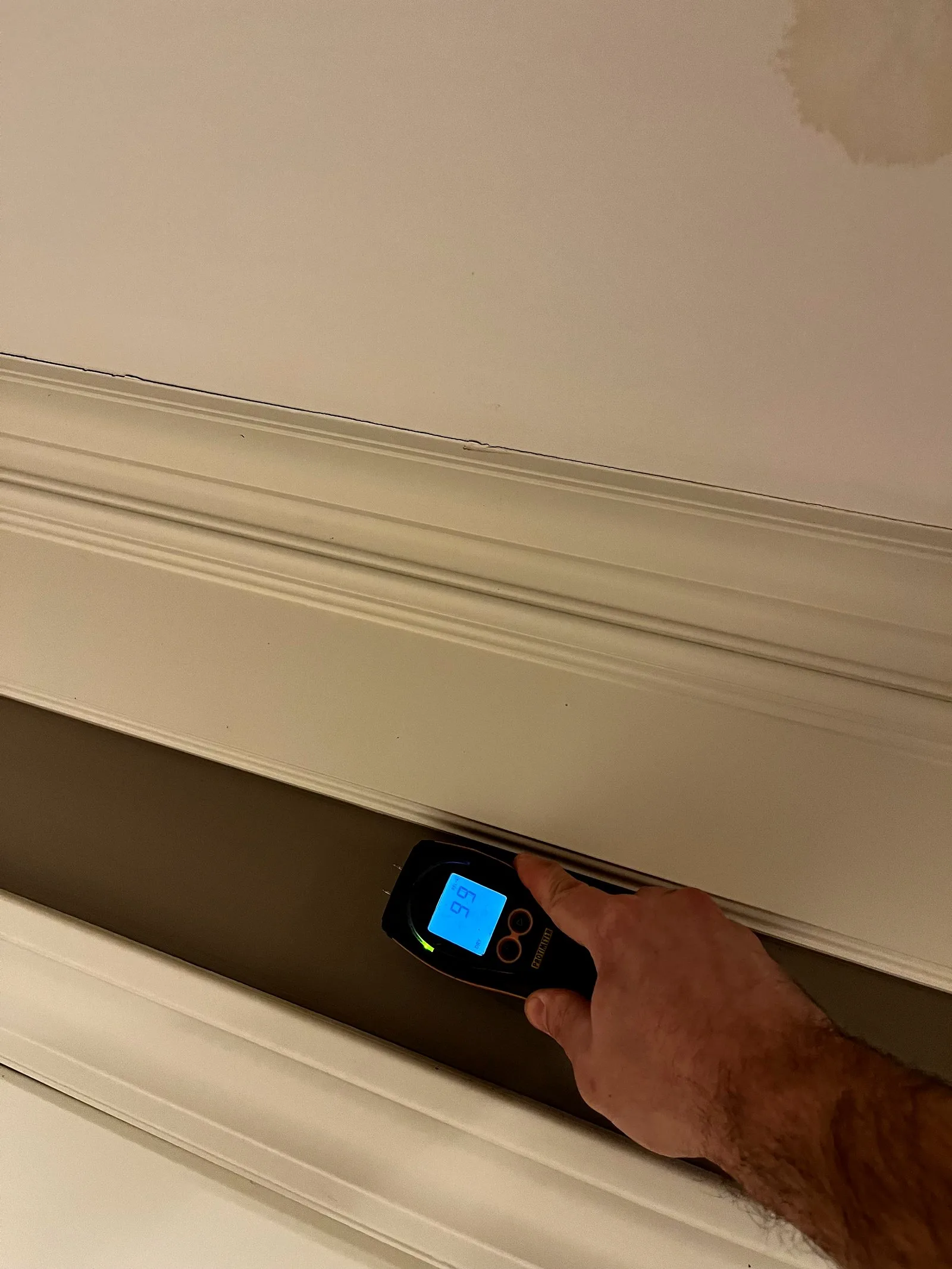 Pre-mold moisture reading — Grandville basement, hour 28 of a slow leak
Mold colonization begins at 24 to 48 hours per IICRC S500 §12.2.1. In sealed Michigan basements at 65–75°F with elevated humidity, we routinely document visible growth at the 36-hour mark. Mold spores are already present in every home — they only need moisture and time.
Most homeowners think of mold as something that takes weeks to appear. The before/after photos online — black wall, contractor in Tyvek — suggest a long, slow-motion process. The truth is that mold colonization in a Michigan basement after a water loss is measured in hours, not weeks. By the time you see fuzz on the drywall, the colony has been working for two to three days.
This article covers the four things mold needs to grow, why Michigan basements specifically grow it faster than the textbook predicts, and what the 36-hour clock looks like inside a real West Michigan house.
What Mold Actually Needs
Mold needs four conditions simultaneously. Remove any one and growth stops:
- Moisture. Material moisture content above roughly 16%. Drywall absorbs to 70%+ when wet. This is the only one we can practically control.
- Food source. Cellulose (drywall paper, wood, cardboard, dust). Modern homes are full of it.
- Temperature. 40°F to 100°F. A heated basement at 65–75°F is mold's preferred zone.
- Time. 24–72 hours for the colony to establish. After that, it self-sustains.
Mold spores themselves are already present in every indoor environment in West Michigan, year round. We do not "introduce" mold to your house when we cut into a wet wall — the spores were already there. The colony just needed the wet condition to wake them up.
Why Michigan Basements Run the Clock Faster
The IICRC S500 number is 24–48 hours. In our field experience across thousands of West Michigan water losses since 1981, the actual visible-growth window in finished basements skews toward the lower end. Three reasons:
1. Sealed building envelope
Michigan basements are heavily insulated and tightly sealed for winter performance. That same seal traps elevated humidity after a water loss. Indoor RH that would normalize quickly in a leaky 1940s home stays elevated for days in a 2010s build.
2. Cellulose-rich materials
Modern construction defaults to paper-faced drywall, OSB subfloor, particleboard cabinet kicks, and fiberglass batt insulation with paper backing. The drywall paper alone is the perfect food source — thin enough to wick water deeply, organic enough to feed colonization.
3. Stable basement temperatures
A finished Grand Rapids basement holds 68–72°F year round. That puts the affected area in mold's optimal growth temperature for the entire colonization window, regardless of season.
"In February 2025 we responded to a Hudsonville pipe burst that the homeowner had discovered Friday night and decided to clean up themselves over the weekend. We were called Sunday afternoon. The water had only sat 38 hours, the homeowner had visibly dried the surface, and we still found visible mold growth on the back side of three drywall sections when we opened the wall on Monday."
The 36-Hour Timeline in a Michigan Basement
| Hour | What is Happening |
|---|---|
| 0–2 | Water enters. Drywall paper saturates from the bottom edge up. Carpet pad absorbs to capacity (about 1 lb of water per sq ft). |
| 2–6 | Capillary wicking carries moisture up the drywall behind baseboards, often invisibly. |
| 6–12 | Indoor RH rises into the 60–75% range. Cool surfaces (concrete walls, metal HVAC trunks) reach dew point and condense. |
| 12–24 | Existing mold spores in the affected materials begin germination. No visible growth yet. |
| 24–36 | Hyphae extend into the substrate. Microscopic colonies form. Musty smell may begin. |
| 36–48 | Visible growth begins on the back side of drywall, in carpet pad, on subfloor underside. Often invisible until walls are opened. |
| 48–72 | Colony self-sustains. Spore production begins. Air sample readings climb. |
| 5–7 days | Visible growth on exposed surfaces. By now you can see it. |
By the time you see mold on the wall, it has been growing for three days behind the wall.
Why "I'll Just Bleach It" Doesn’t Work
Bleach kills surface mold on hard, non-porous surfaces — tile grout, metal, sealed concrete. It does not penetrate drywall, wood, fiberglass, or carpet. The EPA's official guidance specifically recommends against bleach as a mold treatment on porous materials.
The visible black surface stain wipes off. The root structure (mycelia) growing inside the substrate is untouched. Within 2–6 weeks, visible growth returns — sometimes from a slightly different surface point because the colony branched. Plus, the bleach itself adds moisture to the substrate, which can accelerate regrowth.
Professional mold remediation per IICRC S520 requires removal of the colonized porous material entirely — cut out the drywall, dispose of the carpet pad, treat the framing with HEPA vacuum + antimicrobial. Surface treatment is for non-porous materials only.
What Professional Mold Remediation Looks Like
1. Containment
6-mil polyethylene barrier around the affected area, sealed to floor and ceiling, with a double-zip entry. HEPA negative-air scrubber inside the containment, exhausted to outside. HVAC supply and return registers in the zone are sealed.
2. Removal
All visibly contaminated porous materials cut out and bagged in 6-mil contractor bags inside the containment. Drywall removed minimum 24" beyond the visible growth boundary per IICRC S520.
3. HEPA Cleaning
All non-porous surfaces in the containment HEPA-vacuumed. Then EPA-registered antimicrobial applied to remaining structural framing.
4. Drying
Source moisture problem must be solved or the colony returns. Dehumidification continues until structural materials reach equilibrium MC matching unaffected reference areas.
5. Post-Remediation Verification (PRV)
Independent third-party air sampling for indoor mold spore counts. We use Summit Environmental and EMSL Analytical for clearance testing. Air samples must show no significant elevation vs. an outdoor control sample.
6. Rebuild
New drywall, insulation, paint, baseboard, flooring per the original specs. Builder License #2101187907 covers both phases.
Found mold after a water loss?
Containment first — do not start cutting drywall until we’re on site. We dispatch IICRC AMRT-certified crew across Kent and Ottawa County 24/7.
(616) 822-1978Insurance — the Mold Cap
Most Michigan HO-3 policies have a separate mold sublimit, typically $5,000 or $10,000, even when the underlying water loss is fully covered. Carriers built this into policies in the early 2000s after a wave of mold-related lawsuits. The argument is that mold results from negligence (slow leak, late discovery), not from the sudden event itself.
We push back on this aggressively when we have time-stamped moisture readings showing the structure was wet for the duration of a covered loss. But the cap is real and homeowners frequently pay the gap out of pocket. The defense is fast response — if drying begins inside the 24-hour window, mold remediation usually does not become necessary at all.
Frequently Asked Questions
How fast does mold grow after water damage?
IICRC S500 §12.2.1 puts mold colonization at 24 to 48 hours under typical indoor conditions. In Michigan basements at 65–75°F with 60%+ RH, we routinely document visible growth at the 36-hour mark.
What does mold need to grow?
Mold needs four things: moisture (above 16% material moisture content), an organic food source (drywall paper, wood, dust), temperatures between 40°F and 100°F, and oxygen. Remove any one and growth stops. Moisture is the only one we can practically control.
Can I just bleach mold off the wall?
Bleach kills surface mold on hard, non-porous surfaces. It does not penetrate drywall, wood, or insulation, and the EPA specifically recommends against bleach for mold on porous materials. The visible mold returns within weeks because the root structure (mycelia) is unreached.
How much does mold remediation cost in Michigan?
Small contained mold jobs (single bathroom, under 10 sq ft) run $1,400 to $3,200. Bedroom or single-room mold remediation with full containment and HEPA scrubbing runs $3,800 to $7,400. Whole-basement mold from a missed water loss runs $8,500 to $24,000+. Air clearance testing adds $400 to $850 per round.
Does insurance cover mold from water damage?
Most Michigan HO-3 policies cap mold coverage at $5,000 to $10,000 even when the underlying water loss is fully covered. We document the time sequence with moisture readings and photos to push back, but the cap is real and homeowners often pay the difference.