Pipe burst at 4 AM. Now what?
The 7-step sequence we tell every Grand Rapids homeowner who calls during a freeze event — in the order that actually saves you money.
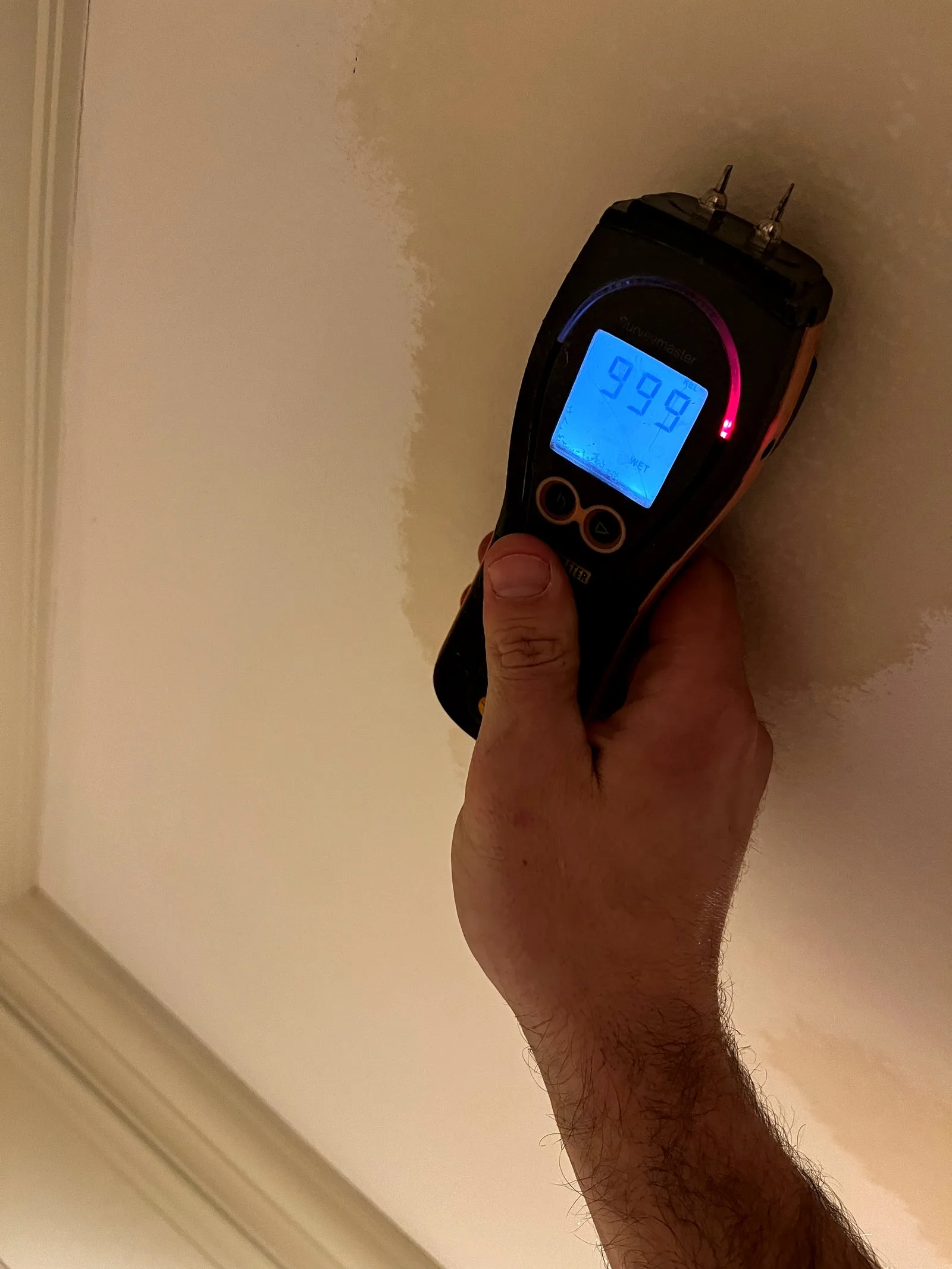 Moisture meter, hour 1 — Rockford pipe burst, January 2026
Shut off the main water valve, cut power to the affected zone, open all faucets to relieve pressure, photograph everything, then call a restoration contractor before the plumber. Do not use an open flame to thaw pipes — that turns a water loss into a structure fire.
If you are reading this with water actively dripping into your house, skip ahead to the seven-step list. If you are reading this in October trying to prepare for winter, the prevention section at the end is the part you want.
Frozen pipe bursts are seasonal. We run them between mid-December and mid-March, with the heaviest concentration during the first deep freeze after a thaw — that's when ice plugs form quickly in pipes that water re-entered during the warm spell. The single worst run we ever logged was the February 2025 polar vortex week: 23 burst-pipe responses in 6 days across Kent and Ottawa County.
The 7-Step First Response (in order)
Step 1: Shut Off the Main Water Valve
Stop the source first. The main shutoff is usually on the front foundation wall near the water meter, or in the basement on the wall closest to the street. Turn clockwise until fully closed. If you do not know where it is, find out tonight — not during an active leak. The lever style takes 5 seconds to close; the wheel style takes 30 seconds and may be stiff if it has not been turned in years.
Step 2: Cut Power to the Affected Area
If water is touching outlets, light fixtures, or appliances, kill the circuit breakers feeding that zone. Standing water plus a live receptacle is an electrocution hazard, not a water loss.
Step 3: Open All Faucets — Lowest First
With the main shut off, open every faucet in the house starting from the lowest point. This drains residual pressure from the system and stops continued dripping from the burst location. It also reveals secondary thaw zones — if a faucet on a different floor will not flow, you may have a second frozen line.
Step 4: Document Before You Move Anything
Phone in landscape. Wide shots of every wall, then close-ups of any wet contents in place. Then a video walkthrough with audio narration. Adjusters pay what you can prove. Most denied claims fail at the documentation stage, not the policy stage.
Step 5: Call a Restoration Contractor (Before the Plumber)
Restoration first, plumber second. The plumber fixes the pipe and leaves; the water has been sitting for those 90 minutes and is now wicking up the drywall. We dispatch a crew at the same time we coordinate the plumber, so source repair and extraction happen in parallel.
Step 6: Do Not Use an Open Flame to Thaw the Pipe
Every winter, the West Michigan fire departments respond to house fires that started as a homeowner trying to thaw a pipe with a propane torch. Open flame near wood framing, fiberglass insulation, or vapor barrier is a structural fire hazard. Use a hair dryer, a heating pad wrapped around the pipe, or wait for the plumber. The pipe is already cracked — thawing it just lets you confirm where the rupture is. There is no rush.
Step 7: Move Salvageable Contents Out
After photos. Anything porous within reach of the wet zone should move to a dry area — cardboard boxes, books, upholstered furniture, electronics. A wet sectional couch on a wet carpet at hour 2 is salvageable; the same setup at hour 24 is not.
"In January 2026 we got a 4 AM call from a Rockford homeowner with a burst supply line on the second floor. The water had been running for about 90 minutes before he woke up. Ground floor ceiling was sagging. He had already shut off the water and photographed the damage. We had him on extraction by 5:15 AM. Total mitigation came in at $6,940 — would have easily been $14,000 if he had not done the first three steps before calling."
Why Pipes Burst (the Actual Mechanism)
Water expands roughly 9% when it freezes. Most homeowners assume the pipe ruptures from the expansion of the ice itself, but that is not what happens. The ice plug forms first, then water continues to push from upstream. The pressure builds between the ice plug and a closed faucet, fitting, or valve downstream — and that is where the pipe gives. The rupture is almost always between the ice and the next closed point, not at the ice itself.
This is why the standard freeze-prevention advice is to leave a slow drip running — the open faucet relieves the pressure before the ice plug builds enough force to rupture the pipe. The drip itself does not prevent the freeze; it prevents the burst.
A frozen pipe is not the failure. A frozen pipe with no pressure relief is.
Where Grand Rapids Homes Most Commonly Burst
- Exterior wall bathrooms — especially second-floor bathrooms above unheated garages
- Hose bib supply lines through the rim joist if not winterized
- Kitchen plumbing on north-facing exterior walls in homes with marginal insulation
- Crawlspace supply lines in older homes without sealed/conditioned crawlspaces
- Garage utility room plumbing when garage doors are left open in deep cold
- Vacation/vacant homes where heat was set too low or shut off
Insurance — the Vacancy Trap
Standard Michigan HO-3 policies cover sudden and accidental water damage from a burst pipe. That is the good news. The bad news is the "reasonable care" requirement.
If your house was unoccupied during the freeze (vacation, second home, snowbird) and you did not either (a) maintain heat at 55°F or above, or (b) shut off the water and drain the lines, the carrier may deny coverage entirely. Smart thermostats with low-temp alerts (Nest, Ecobee) and water-leak smart shutoff valves (Phyn, Moen Flo) are now standard recommendations from us for any property unoccupied more than 48 hours in winter.
Prevention Checklist (do this in October, not January)
- Insulate exposed pipes in unheated spaces with foam pipe sleeves — $1.50/ft, takes 20 minutes per pipe
- Install heat trace cable on lines in crawlspaces or rim joists — $40–$80, plug-in
- Disconnect garden hoses and shut off interior valves to hose bibs by November 1
- Identify your main shutoff and confirm it actually closes — do this in fall, not during an emergency
- Set thermostat no lower than 60°F when you leave for vacation in winter
- Install a smart leak shutoff valve (Phyn, Moen Flo) for any vacation property — $400–$700 installed, prevents the multi-day undetected leak that destroys vacant houses
- During a deep freeze (sustained below 15°F), open cabinet doors under sinks on exterior walls to let warm room air reach the pipes
- Leave a pencil-thin trickle running on faucets fed by exterior wall plumbing during the worst overnight cold
Pipe burst happening right now?
Shut off the main, photograph, then call. We dispatch in under 60 minutes across Kent and Ottawa County, 24/7/365.
(616) 822-1978Frequently Asked Questions
What temperature do pipes burst at in Michigan?
Pipes are at risk of freezing when sustained outdoor temperatures stay below 20°F for several hours. The danger temperature is not the freeze itself — water expands roughly 9% when it freezes. The burst happens when the ice plug forces pressure against a closed faucet or valve and the pipe ruptures, often at a fitting.
Where do pipes most commonly burst in Grand Rapids homes?
Exterior wall plumbing in unheated bathrooms, lines feeding hose bibs through rim joists, kitchen plumbing on north-facing exterior walls, and supply lines running through unheated crawlspaces. PEX is more freeze-tolerant than copper but still ruptures at fittings under sustained pressure.
Does insurance cover frozen pipe damage in Michigan?
Standard HO-3 covers sudden and accidental water damage from a burst pipe. The exclusion most homeowners run into is the 'reasonable care' clause: if your house was unoccupied during a freeze and you did not maintain heat or shut off and drain the water, the carrier may deny coverage. For vacant or vacation properties, the standard is heat maintained at 55°F+ or water shut off and lines drained.
How long does frozen pipe restoration take?
Standard frozen pipe water damage in a Grand Rapids home reaches dry standard in 3 to 5 days for a single floor. If water traveled through the ceiling or affected the basement, drying extends to 5 to 7 days. Reconstruction starts after drying confirms and takes another 1 to 3 weeks depending on scope.
Can I prevent frozen pipes for next winter?
Three measures eliminate 90% of freeze risk: insulate any pipes in unheated spaces with foam pipe sleeves, install heat trace cable on lines in crawlspaces or rim joists, and leave a slow drip on faucets fed by exterior wall plumbing during cold snaps below 15°F. Total cost under $200 per home; prevents a $5,000+ loss.