Water heater leaking? What to do in the first 30 minutes, and who to call in Grand Rapids.
The safe order of steps, how to tell where the water is coming from, when the tank has to be replaced, and what to do about the water it left behind.
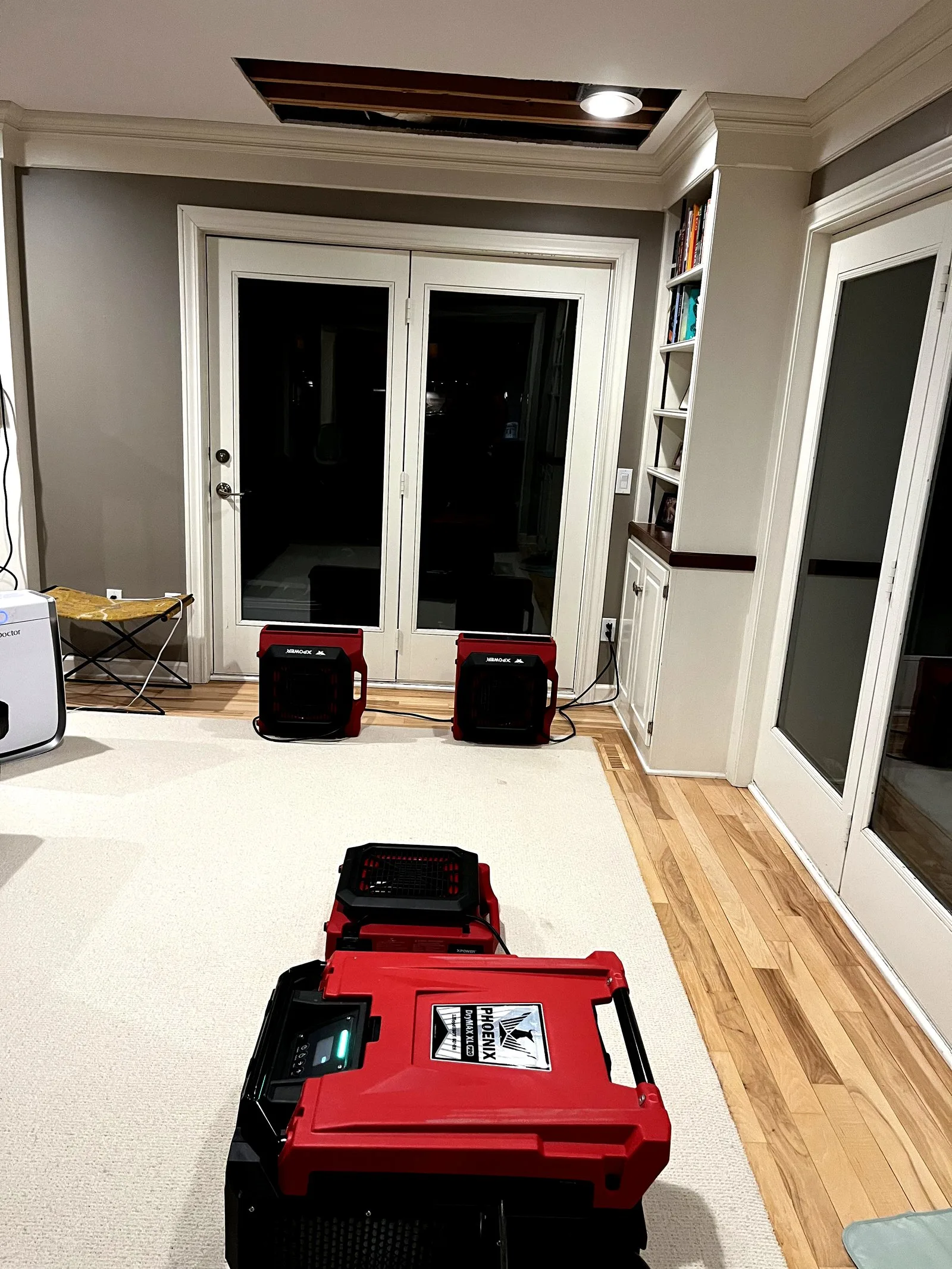 Air movers and a dehumidifier drying a room on one of our Grand Rapids water damage jobs. The heater is the plumber’s job; the water it leaves behind is a drying job.
If you smell gas, leave the house and call 911 and your gas company from outside. Otherwise: turn off the power or gas to the heater, close the cold water valve that feeds it, move your belongings out of the water and take photos. Do not drain a hot tank straight away: let the hot water run from a faucet until it is cool first. Then find where the leak is. A leak from the fittings or a valve can often be fixed. Water from the tank itself usually means the heater must be replaced. Call a plumber for the heater, and a water damage company if the water has reached walls, flooring or other rooms.
A water heater leak can be a slow drip on the floor or a tank that empties into your basement. Either way, the first half hour matters, and the order you do things in matters too. This guide covers what to do right now, how to tell where the water is coming from, when the heater has to be replaced, and what happens to the house afterwards.
Our sources are A.O. Smith (one of the largest water heater makers) and its owner’s manual, Lennox, DTE Energy, the U.S. Geological Survey, the City of Grand Rapids, the Insurance Information Institute and the standard homeowners policy form. We are a water damage restoration company in Grand Rapids, so drying out homes after leaks is work we sell.
What to do in the first 30 minutes
- If you smell gas, get out first. A gas water heater can be part of a gas problem. DTE Energy’s advice is to leave the area immediately, then call 911 from a safe place and the DTE Gas Leak Hotline at (800) 947-5000. Do not use light switches, phones or appliances inside, do not light anything, and do not go back in until first responders or the gas company say it is safe. If another company supplies your gas, call theirs.
- Turn off the power or the gas. For an electric heater, switch off its breaker at the electrical panel. For a gas heater, turn the gas control knob on the heater to OFF, and close the gas shut-off valve on the supply line if you are confident doing so. If the water has reached outlets, cords or the electrical panel, stay out of it. Water and electricity together are a shock hazard.
- Shut off the water to the heater. Close the shut-off valve on the cold water pipe that feeds the heater, usually above it. If that valve is stuck or there is not one, close your home’s main water shut-off.
- Protect the house and take photos. Move boxes, rugs and furniture out of the water, mop or wet-vacuum what you can, and photograph the heater, the water and anything damaged before you clean up. Lennox recommends the photos for your insurance claim.
- Only drain the tank if you have to, and let it cool first. If water keeps coming out of the tank, it can be emptied through the drain valve near the bottom with a garden hose run to a floor drain or outside. A.O. Smith’s owner’s manual says to open a hot water faucet and let the hot water run until it is cool before you drain, which can take 10 minutes or longer, to reduce the risk of scalding. Sediment can clog the drain valve. If the tank will not drain, leave it to a plumber.
- Call the right people. A licensed plumber repairs or replaces the heater. If the water has spread past the area around the heater, soaked into drywall or carpet, or reached a finished basement, call a water damage company as well. More on that below.
Where is the water coming from?
Dry the area around the heater and watch where new water appears. Lennox suggests doing this before anything else, because the water is sometimes from a nearby pipe, not the heater. The location tells you a lot.
- Top of the heater. The cold inlet and hot outlet connections can loosen over time. A.O. Smith says tightening them gently with a wrench sometimes fixes it, but over-tightening can damage the fitting.
- The pipe down the side (the relief valve). This is the temperature and pressure (T&P) relief valve. Its job is to release water if the temperature or pressure in the tank gets too high. A.O. Smith’s manual says a small drip usually means your home’s water pressure is too high or you need a thermal expansion tank. A large amount of very hot water may mean the tank is overheating: turn the gas or power off and call a qualified person. The manual is blunt about one thing: do not cap or plug the relief valve or its pipe, because a blocked valve could cause an explosion.
- The drain valve near the bottom. It can loosen or wear out. Lennox and A.O. Smith both say this is usually fixable by tightening or replacing the valve.
- The tank itself, or the base. A.O. Smith calls a leak from the base “often the first indication of a serious problem”, usually a corroded tank. Lennox says moisture on the tank body likely means corrosion has made a hole that cannot be fixed. In both cases, plan on a new heater.
- Not a leak at all. A.O. Smith’s manual says a gas heater heating a tank of cold water often forms condensation, which can drip or leave a small puddle, and goes away once the tank is up to temperature.
Repair or replace?
Loose fittings, a worn drain valve and a faulty relief valve are repairs. A corroded or cracked tank is not. A.O. Smith says water heaters typically last between 8 and 20 years depending on the type, and that for an old heater it is usually more cost-effective to replace than repair. Lennox puts most heaters at 8 to 12 years. The manual itself is frank: due to the normal corrosive action of water, the tank will eventually leak.
Was your water heater under water in a basement flood?
This one surprises people. A.O. Smith’s gas water heater manual says that if the heater has been through flood conditions, or its control has been under water, the entire water heater must be replaced. If the wiring, controls or insulation have got wet in any way, it says to shut the heater off and have it inspected by a qualified person before using it. Do not relight a heater that sat in flood water. See our guide on what to do if your basement floods.
Grand Rapids water is hard, and that matters for your tank
The City of Grand Rapids’ 2025 water analysis for its Lake Michigan Filtration Plant shows an average hardness of 142 mg/L (8.3 grains per gallon) at the plant tap. On the U.S. Geological Survey’s scale, 121 to 180 mg/L counts as hard water.
The USGS explains why that matters: when hard water is heated, as in a home water heater, deposits of calcium carbonate form. That scale can shorten the life of equipment and lower the efficiency of electric water heaters. A.O. Smith adds that sediment collecting at the bottom of the tank can cause overheating, cracks and leaks, and that hard-water corrosion cannot be repaired. Homes on wells or on other water systems will have different numbers, so check your own water.
If you use a water softener, A.O. Smith’s manual says the anode rod (the metal rod that protects the tank from corrosion) wears out faster, so have it checked more often.
Water heater leaked into your home?
We extract the water, find the moisture hidden in walls and floors, and dry the structure, 24/7 across Kent and Ottawa County. We are there in under 60 minutes on most calls, and we bill your insurer directly.
(616) 822-1978Who to call: a plumber, a restoration company, or both
Think of it as two problems. The heater is a plumber’s job. The water that came out of it is a drying job. A tank holds a lot of water: Lennox notes a tank failure can release 40 to 80 gallons. That water soaks into carpet pad, drywall, baseboards and subfloors, and much of it is out of sight.
Call a water damage company if:
- the water has spread beyond the area right around the heater;
- it has reached drywall, carpet, cabinets or a finished basement;
- the leak may have been running for a while before you found it; or
- you can smell mustiness or see stains.
Timing matters. The EPA says that if wet materials are dried within 24 to 48 hours after a leak, in most cases mold will not grow. That is a deadline for drying, not a promise that mold appears on day three. Our guide to what water mitigation includes explains what the drying work involves. If you are in the city, see our page on water damage restoration in Grand Rapids.
Does insurance cover a leaking water heater?
Usually the damage, rarely the heater. We read the standard homeowners form (ISO HO 00 03, 2011 edition):
- The water damage is usually covered. The form covers loss from an accidental discharge or overflow of water from a plumbing or heating system or a household appliance. The Insurance Information Institute lists the same peril for the common policy types.
- The heater itself usually is not. The form says: “We do not cover loss to the system or appliance from which this water or steam escaped.”
- Slow problems are excluded. Wear and tear, deterioration, mechanical breakdown, rust and other corrosion are excluded, and the Insurance Information Institute says policies do not cover damage due to lack of maintenance. If a leak ran for a long time before anyone noticed, expect the insurer to ask about these exclusions.
Your own policy and endorsements may differ, so read them and call your insurer. Take photos before cleanup and keep receipts for anything you spend to stop the damage. Our guides on water damage and insurance in Michigan and what to document for a claim go further.
How to stop it happening again
- A drain pan and a leak detector. A.O. Smith recommends a metal drain pan under the heater, piped to a drain, and says most codes require one. It also recommends an automatic leak detection and shut-off device, which can close the heater’s water supply if it senses a leak.
- Check the water pressure. The manual says high pressure can cause premature leaks, and recommends a pressure-reducing valve set to 50 to 60 psi. Lennox suggests acting if pressure is consistently above 80 psi.
- A thermal expansion tank. Water expands when heated. The manual says almost all homes now need an expansion tank, and that a dripping relief valve is often a sign one is missing.
- Yearly maintenance. The manual recommends draining and flushing the tank and checking the anode rod after the first six months and at least once a year after that, and operating the relief valve once a year. Hot water comes out when you do, so make sure the pipe discharges somewhere safe and stand clear.
- Look at it. Glance at the floor, pan, valves and pipes around the heater regularly, and fix small drips early.
- Plan ahead on an old heater. If yours is near the end of its life, replacing it on your schedule is cheaper than replacing it after it fails.
Frequently Asked Questions
What should I do first if my water heater is leaking?
If you smell gas, leave the house first and call for help from outside. Otherwise, turn off the power (electric) or set the gas control to OFF (gas), then close the cold water valve on the pipe that feeds the heater. Move belongings away from the water, take photos, and call a plumber about the heater.
Is a leaking water heater an emergency?
Treat it as urgent. A.O. Smith says even minor leaks can quickly cause water damage and mold problems, and that a leak from the base of the tank is often the first sign of a serious problem. A large amount of very hot water coming out of the relief valve pipe can mean the tank is overheating: turn the gas or power off and call a qualified person.
Can I still use water if the water heater is leaking?
Not hot water from that heater. A.O. Smith says not to keep using a leaking water heater. If you only closed the cold water valve that feeds the heater, the cold water in the rest of the house normally still works. If you had to close the main water shutoff, nothing will run until it is opened again.
Can I still shower if my hot water heater is leaking?
Only once a plumber has fixed it, or with cold water if you only closed the heater’s own valve. With the heater shut off and its water supply closed, there is no safe hot water to draw from it.
Why is my water heater leaking from the bottom?
Check the drain valve first. A loose or worn drain valve can often be tightened or replaced. If water is coming from the tank itself, A.O. Smith and Lennox both say the tank has usually corroded through, and a corroded tank cannot be repaired. Condensation can also drip to the floor when a gas heater first heats a tank of cold water.
Why is water coming out of the pipe on the side of my water heater?
That pipe comes from the temperature and pressure (T&P) relief valve. A.O. Smith’s manual says a small drip usually means your water pressure is too high or you need a thermal expansion tank. A large amount of very hot water may mean the tank is overheating. Never cap or plug that valve or its pipe.
How long will a water heater last once it starts leaking?
A leak from a loose fitting, the drain valve or the relief valve can usually be fixed. A leak from the tank itself is the end of that heater: corrosion through the tank cannot be repaired, and the leak will get worse. Plan to replace it soon, and keep the power, gas and water to it off until then.
Does homeowners insurance cover a leaking water heater?
Usually the water damage, not the heater. The standard homeowners form covers damage from an accidental discharge of water from a household appliance, but says it does not cover loss to the appliance the water escaped from. Wear and tear, corrosion and mechanical breakdown are excluded. Your policy may differ, so check it and call your insurer.