A pipe burst in your house: what to do in the first ten minutes, how to tell if it is inside a wall, and who to call.
Shutting off the water safely, signs of a hidden leak, why pipes burst, who handles what in Grand Rapids, the damage to check, insurance and what affects the cost.
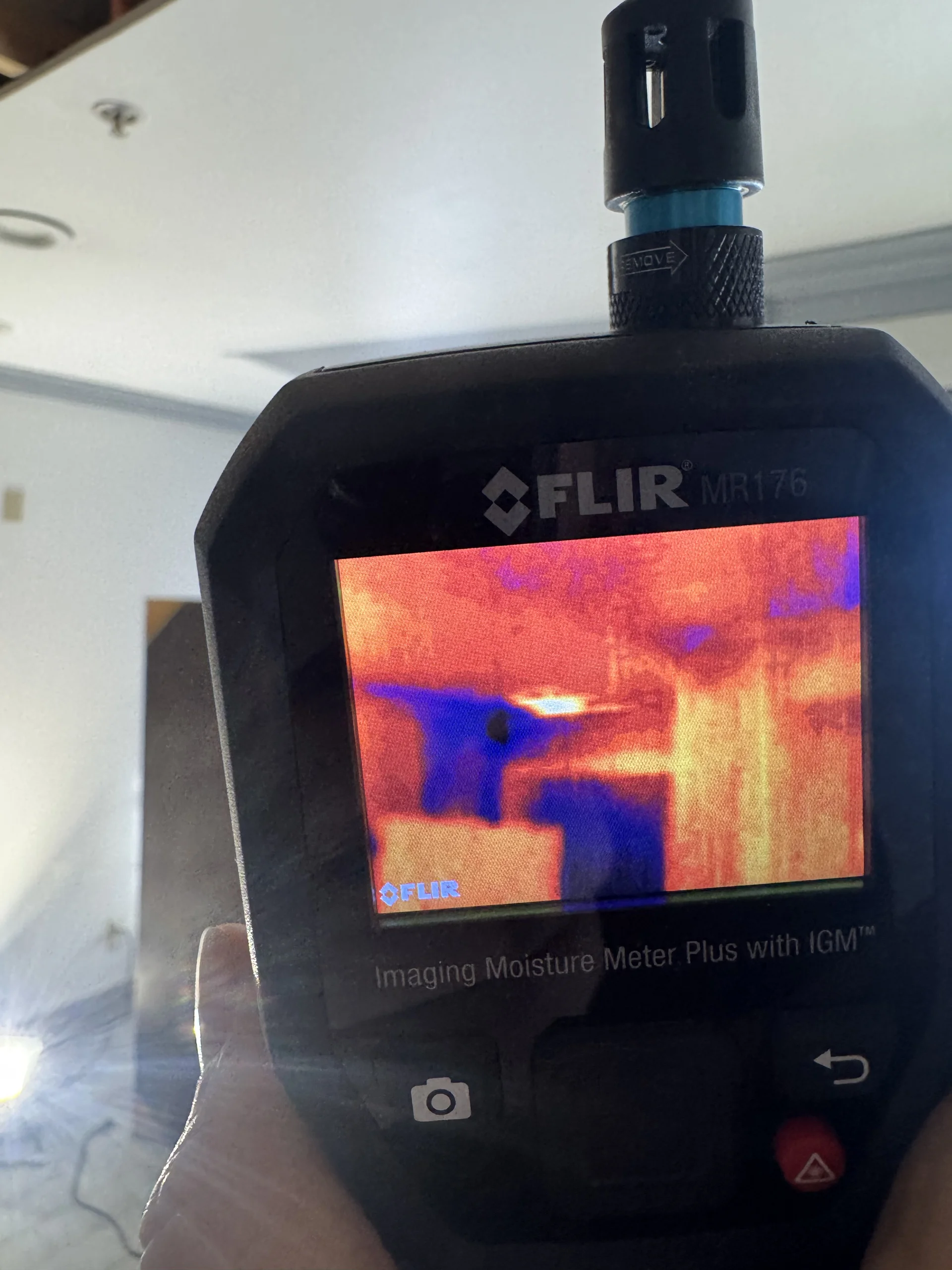 A thermal imaging moisture meter showing a wet area on a wall.
Shut off the main water valve right away. It is usually near the water meter, where the water line enters the house. Turn off the water heater if hot water lines are involved, open a faucet to drain the pipes, stay away from water near outlets and the electrical panel, and take photos. Then call a plumber to fix the pipe and a restoration company to remove the water and dry the walls, ceilings and floors. Water left for more than 24 to 48 hours can lead to mold.
A burst pipe is one of the most common emergencies in a Michigan winter, and one of the most expensive if it is left running. Even a small crack can leak a lot of water: an eighth-inch crack can let out up to 250 gallons a day. This guide covers what to do in the first few minutes, how to tell if a pipe has burst inside a wall, who to call, and what happens next.
The first ten minutes
- Shut off the main water valve. In most homes it is near the water meter, often in the basement where the water line comes through the foundation. Grand Rapids homes are required to have a valve on each side of the meter. A round handle turns clockwise until it stops; a lever takes a quarter turn.
- Turn off the water heater if the leak is on a hot water line, or if you are draining the whole system.
- Open a faucet to drain the water left in the pipes, so it runs out of the faucet instead of the split.
- Stay safe around electricity. Do not use electrical appliances in standing water. Turn off the power only if you can reach the panel from a dry spot. If you would have to step into water, call an electrician instead, and have the system checked before the power goes back on.
- Keep away from a sagging ceiling. A ceiling holding water can come down.
- Take photos and video of the water, the damage and the pipe before anything is cleaned up or thrown away.
- Make the calls: a plumber for the pipe, a restoration company for the water, and your insurance company.
It is worth finding your main shut-off valve now, before you ever need it, and making sure everyone in the house knows where it is.
Signs a pipe has burst inside a wall or ceiling
Not every burst pipe announces itself with a spray of water. A pipe inside a wall or ceiling can leak for a while before you notice. Watch for:
- water stains or damp patches on walls or ceilings;
- paint that bubbles, peels or cracks, or wallpaper that lifts;
- drywall that feels soft or looks swollen, or a ceiling that sags;
- a musty smell in one room or one wall;
- the sound of running or dripping water when nothing is turned on;
- puddles along the bottom of a wall, or wet carpet with no obvious cause;
- a water bill that jumps for no reason.
The water meter test: read your water meter, use no water at all for two hours, then read it again. If the reading has changed, you probably have a leak somewhere. Moisture meters and thermal cameras can then show where the water is inside the wall without tearing it open first.
Why pipes burst
- Freezing. Water expands when it freezes, and the pressure can split both plastic (PVC) and copper pipes. The pipes that freeze most are those against outside walls with little insulation, and those in unheated basements, crawl spaces, attics, garages and kitchen cabinets.
- Age and wear. Old fittings, corrosion and damaged pipes can give way without any freeze.
A frozen pipe does not always burst where the ice is. If a faucet gives only a trickle in cold weather, suspect a frozen pipe and deal with it before it splits. Our guide on how to find a frozen pipe and thaw it safely walks through it.
Pipe burst? Water in the walls or ceiling?
Shut off the main and call. We remove the water, find where it has spread and dry the building across Grand Rapids and West Michigan, 24/7.
(616) 822-1978Who to call
- A plumber repairs or replaces the broken pipe.
- A water damage restoration company removes the water, finds where it has spread inside walls, ceilings and floors, and dries the building properly. Most burst pipes need both.
- Your insurance company, as soon as the water is under control.
- The city, if the break is on its side. In Grand Rapids, the homeowner is responsible for the water line from the curb stop, the small valve near the property line, through the yard and throughout the house. The city is responsible for the line from the main to the curb stop, the water meter and the couplings on either side of it. The city's 24-hour emergency repair line is (616) 456-3000. If a city-side break damages your property, you can file a claim with the city.
What happens to your walls, ceilings and floors
Once the pipe is fixed, the water it left behind is the bigger job. Anything that stays wet for more than 24 to 48 hours is at risk of mold, so drying needs to start quickly.
- Drywall can sometimes be dried in place if it has not swollen and the seams are intact. If not, the wet section is cut out and replaced. See water-damaged drywall: dry or replace?
- Insulation inside a wet wall or ceiling usually has to be removed and replaced.
- Ceilings holding water need careful handling. See water leaking from the ceiling.
- Hardwood floors need slow, careful drying and a check of the subfloor. See water-damaged hardwood floors.
- Carpet soaked by clean water from a burst supply line can often be saved if it is dried quickly, though the pad usually goes. See wet carpet: can it be saved?
Does insurance cover a burst pipe?
Standard homeowners policies usually cover sudden water damage from a burst pipe, including pipes that burst from freezing. A few things to know:
- Slow leaks are different. Damage from a leak that went on for a long time is usually excluded as continuous or repeated leakage.
- Flood is different. Water coming in from outside is not covered by a standard policy. Sewer and drain backup usually needs an extra endorsement.
- Keep the heat on. Keep your home warm in winter, at least 65 degrees, and when you are away for a long time have someone check the house so a problem is caught quickly.
- Document everything. Take photos and video, and do not throw damaged items away until your insurer says you can.
Read your policy and talk to your agent if you are unsure what it covers. Our guides to whether homeowners insurance covers water damage in Michigan and documenting a water damage claim go into more detail.
What affects the cost
A burst pipe usually means two bills: the plumbing repair and the water damage. The plumbing cost depends on where the pipe is and how hard it is to reach. The water damage cost depends on how long the water ran, how far it spread, and how much drywall, insulation, flooring and ceiling has to be removed and replaced. The two things that keep the cost down most are shutting the water off fast and starting the drying quickly.
Preventing the next one
- insulate pipes in crawl spaces, attics, garages and along outside walls, and seal cold air leaks near pipes;
- in very cold weather, let a cold tap drip on pipes that are exposed, and open kitchen and bathroom cabinet doors on outside walls;
- keep the thermostat at the same temperature day and night during cold snaps;
- when you go away in winter, keep the heat on, no lower than 55 degrees, and have someone check the house; for long trips, shut off and drain the water;
- disconnect garden hoses and shut off and drain outside faucets before winter.
Getting help in Grand Rapids
If a pipe has burst in your Grand Rapids area home, we can remove the water, use moisture meters and thermal imaging to find where it has spread inside walls and ceilings, dry the building and handle the repairs. See our water damage restoration service in Grand Rapids.
Frequently Asked Questions
What happens if a pipe bursts in your house?
Water keeps pouring out until the supply is shut off. Even a small crack can leak a lot: an eighth-inch crack can let out up to 250 gallons a day. The water soaks into walls, ceilings, insulation and floors, and anything that stays wet for more than 24 to 48 hours is at risk of mold. Shutting off the main valve fast and starting to dry quickly keeps the damage down.
What should I do first when a pipe bursts?
Shut off the main water valve, usually found near the water meter where the water line comes into the house. Turn off the water heater if hot water lines are involved, open a faucet to drain the pipes, stay away from water near outlets and the electrical panel, and take photos. Then call a plumber to fix the pipe and a restoration company to remove the water and dry the building.
How do I know if a pipe burst inside a wall?
Look for water stains, bubbling or peeling paint, soft or swollen drywall, a sagging ceiling, a musty smell, the sound of running water when nothing is on, or puddles along the bottom of a wall. A simple test is to read your water meter, use no water for two hours, and read it again. If the reading changed, there is probably a leak.
Does homeowners insurance cover a burst pipe?
Standard homeowners policies usually cover sudden water damage from a burst pipe, including pipes that burst from freezing. Damage from a slow leak that went on for a long time is usually excluded, and flooding from outside is not covered by a standard policy. Read your policy, take photos, and talk to your insurer before throwing damaged items away.
What causes a water pipe to burst?
In Michigan, freezing is the most common cause. Water expands as it freezes and can split both plastic and copper pipes. Pipes against outside walls with little insulation and pipes in unheated basements, crawl spaces, attics and garages freeze most often. Age, corrosion and damage can also cause pipes to fail.
How much does it cost if a pipe bursts?
There are two bills: the plumbing repair and the water damage. The plumbing cost depends on where the pipe is and how hard it is to reach. The water damage cost depends on how long the water ran, how far it spread, and whether drywall, insulation, flooring or ceilings have to be removed. Shutting off the water fast and starting drying quickly is the biggest thing you can do to keep the cost down.
Who is responsible for a broken water pipe in Grand Rapids?
In Grand Rapids, the homeowner is responsible for the water line from the curb stop, the small valve near the property line, through the yard and throughout the house. The city is responsible for the line from the water main to the curb stop, the water meter and the couplings on either side of the meter. The city has a 24-hour emergency repair line at (616) 456-3000.
Can I stay in my house after a pipe burst?
Often, yes, once the water is shut off, the electrical system is safe and the wet areas are being dried. Stay out of rooms with standing water near outlets, cords or appliances, and keep away from sagging ceilings. If the water reached the electrical panel or wiring, have an electrician check it before the power goes back on.